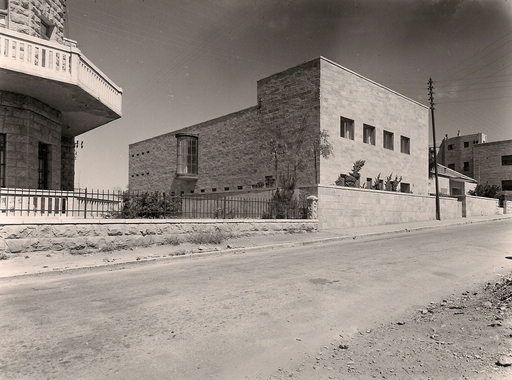
The library building constructed in the Rehavia neighborhood of Jerusalem (Balfour Street 6) between 1935 and 1936 for the bibliophile businessman and publisher Salman Schocken (1877–1959) is a rarity: Not only is it preserved as an authentic architectural structure, including its interior furnishings, it also continues to serve its original purpose into the present day – since 1961 under the aegis of the Jewish Theological Seminary. Designed by the renowned architect Erich Mendelsohn (1887–1953), who immigrated from Berlin in 1934, it was conceived by Schocken as a semi-public space of academic research and encounter.
Schocken’s book collection, which could be salvaged from Germany just in the nick of time, originally comprised around 60,000 volumes – including numerous original manuscripts, valuable Judaica and Hebraica, as well as first editions of German classics. Mendelsohn created a home for this collection consisting of the outside of a formally reserved two-story structure made from pale limestone (meleke). On the inside, the library exudes a bright, almost cheerful atmosphere. The large reading room on the upper floor, which consists entirely of satinwood, is augmented with a protruding semicircular glass oriel window. Schocken’s precisely cataloged collection of books – which is today no longer located in its entirety in Jerusalem – is housed in three low storage rooms at the rear of the building. The library building occupies almost all of the narrow, elongated property, leaving only a modest strip for plants and a south-facing terrace. In a sense, the Schocken Library embodies the architectural presence of a German-Jewish ‘intellectual aristocracy’ in Israel and today testifies to German-Jewish cultural heritage.
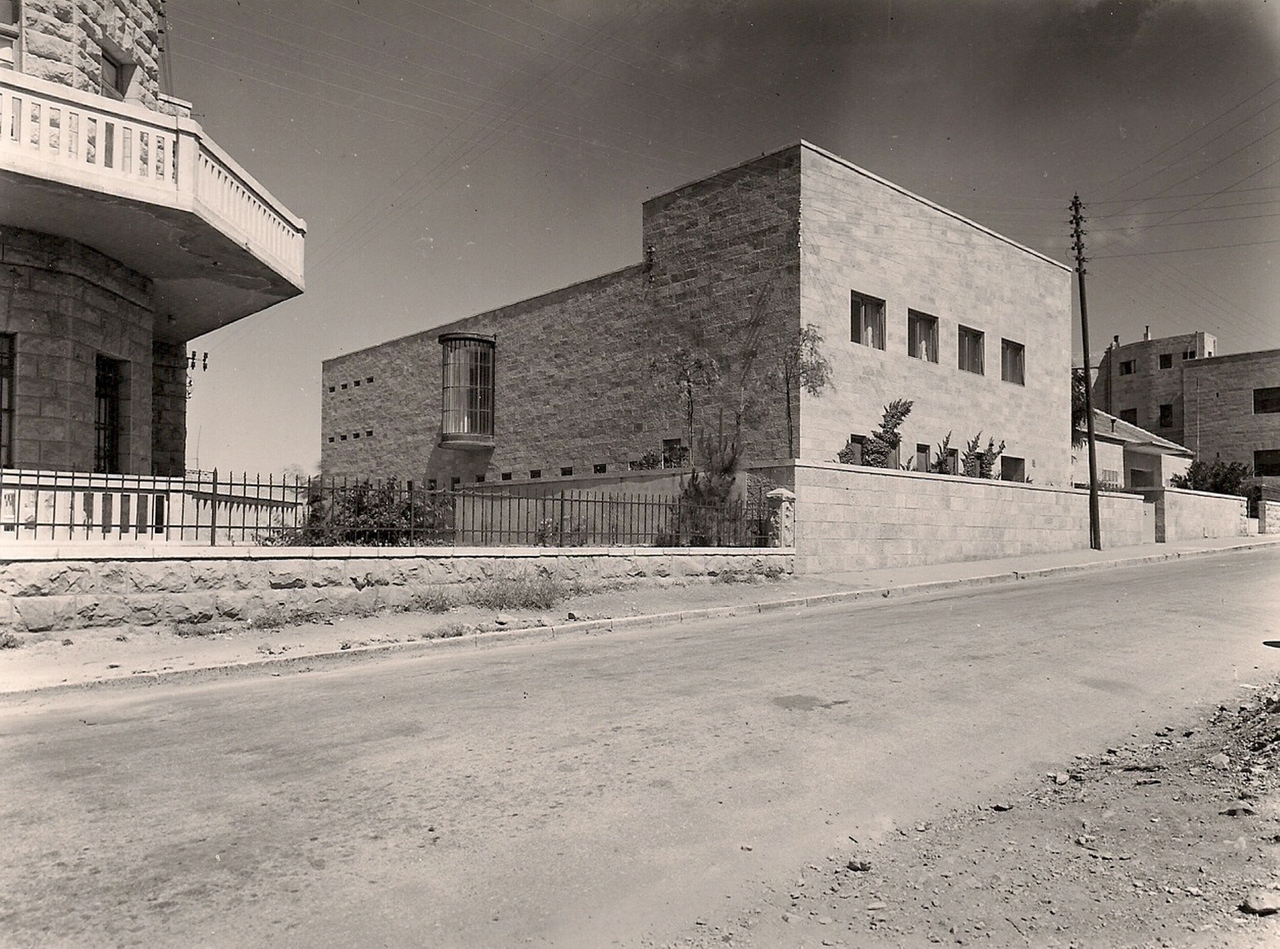
Fig. 1: View from the southeast of the library building, seen from Balfour Street, photographed by Alfred Bernheim around 1938; Israel Museum, Jerusalem.
On the evening of 27 June 1939, half of Rehavia met in the great hall of the Schocken Library in Jerusalem to attend a reading by the author Else Lasker-Schüler (1869–1945), who had immigrated from Berlin via Zurich. The event was instigated by her friend, the painter and architect Leopold Krakauer (1890–1954), and his wife Grete Krakauer (1890–1970), with the support of Luise Mendelsohn (1894–1980), wife of the architect Erich Mendelsohn. The sale of tickets generated a revenue of ten Palestinian Pounds, enough for the destitute author to get by on for two, perhaps even three months. Contrary to the host Salman Schocken’s fears – the poet was known for her abusive remarks toward unruly listeners – the evening was a success. Else Lasker-Schüler beguiled her audience with her poems and her style of presentation. Consequently, Schocken bestowed a small, lifelong pension onto this “most intimate Hebrew” (Kurt Pinthus), thus adopting her into the circle of authors he patronized. This included, among others, the two philosophers Gershom Scholem (1897–1982) and Martin Buber (1878–1965), Buber’s son-in-law Ludwig Strauss (1892–1953), and, from an early time and with the highest priority, Samuel Yosef (Shai) Agnon (1887–1970). In Agnon, Schocken saw great potential for the creation of a new and genuinely Hebrew-Jewish literature. Beginning in 1913, he awarded the Galician-born author, who had lived in Berlin for many years and had emigrated to Palestine in 1928, a constantly rising salary. This was intended to allow Agnon to concentrate entirely on his writing.
One can only speculate how many of Agnon’s novels, which comprise twenty-four volumes, would never have been written without Schocken’s generous support. In 1966, seven years after the death of his patron, Agnon would be the first Hebrew-language author to be awarded a Nobel Prize in Literature.
If Agnon’s stories constituted the most important pillar of the Hebrew-language department of the Schocken Publishing House, founded in Berlin in 1931, then the great philosopher of dialogue Martin Buber was the most significant author for the publisher’s German-language sector. His ‘Verdeutschung’ (Germanization) of the Hebrew Bible, which he began together with the philosopher Franz Rosenzweig (1887–1929), formed the foundation of the media company up to its forced closure in December 1938. The publishing house regarded its book program – especially following the assumption of power by Adolf Hitler (1889–1945) – as an act of intellectual self-assertion: It helped Jewish authors to publish their works with a fair honorarium while at the same time offering – at least during the act of reading itself – a spiritual home to a reading audience that was becoming increasingly ostracized from its environs. It was the publisher’s self-declared goal to “establish a house of Jewish education.” Anzeige des Schocken Verlags, Berlin, in: Jüdische Rundschau, 17 April 1935, 9.
As its commercial director Lambert Schneider (1900–1970) recalled, the publishing house was “the meeting place of all the Jews still conducting intellectual work in Germany at the time.” Cited in Anatol Schenker, “Der Schocken Verlag in Berlin,” in: Antje Bormann/Doreen Mölders/Sabine Wolfram (ed.), Konsum und Gestalt. Leben und Werk von Salman Schocken und Erich Mendelsohn vor 1933 und im Exil, Berlin: Hentrich & Hentrich, 2016, 222–234, 233. Following the establishment of the Schocken Publishing House Ltd. in Tel Aviv in 1937, the company’s publishing activities were initially transferred to Mandatory Palestine. Then, in 1945, Schocken Books was established in New York, which brought the literary works, among others, of the Prague-born author Franz Kafka (1883–1924) into American households.
The Schocken Library in Jerusalem performed a similar function to the Schocken Publishing House in Berlin, but in a reversed situation: It became an intellectual home for the German-speaking intelligentsia that immigrated from Europe in the 1930s. It was precisely the German language – which would for many years in Israel still be disparaged as the language of the perpetrators – that represented intellectual survival, protection, and self-affirmation to these migrants, many of whom did not speak Hebrew. In this context, the Munich-born author and scholar of religion Schalom Ben-Chorin (1913–1999) spoke of an “indestructible homeland of words.” Schalom Ben-Chorin, Zwischen neuen und verlorenen Orten. Beiträge zum Verhältnis von Deutschen und Juden, Munich: DTV, 1988, 28. Academics were not insusceptible to this problem, on the contrary: Due to their demand for linguistically precise and sensitive forms of expression, they often found it more difficult to acquire a new vocabulary than other professional groups.
The Schocken Library constituted an island within this linguistic dilemma. Aside from hosting evening lectures, the library provided access for scholars and researchers alike to the largely German-language book collection housed on three floors at the rear of the building. In his youth, Salman Schocken had himself already indulged in his ‘bibliophilia.’ At first, he bought cheap editions of the publisher Reclam, and later, when his income started to increase, he began acquiring first editions and original manuscripts. A list of his acquisitions at the age of 17 comprises, among others, authors like Spinoza, Kant, Schopenhauer, Emerson, Wilhelm von Humboldt, Montaigne, Rousseau, Aeschylus, Dostoyevsky, and Nietzsche. Yet his greatest, unfettered, and lifelong appreciation was directed at Johann Wolfgang von Goethe (1782–1832). The website of the Schocken Foundation claims that it includes the largest collection of works by Goethe in the world, comprising 2000 volumes, including valuable manuscripts such as the notebooks for the writer’s autobiography and handwritten notes on Faust II. The author Thomas Mann (1875–1955) is said to have regarded Schocken as one of the most important connoisseurs of Goethe.
While Salman Schocken’s interests through to age 30 were predominantly focused on German and European classics, this changed following his reading of Martin Buber’s Die Geschichten des Rabbi Nachman (The Stories of Rabbi Nachman, 1906). This work granted him access to the Eastern European world of Jewish religious tradition and its mysticism, steeped in humor and irony. From 1907 onward, Schocken began collecting Hebrew books – especially first editions, rare prints, and incunabula – on the basis of which he dove into Jewish history and retraced Jewish migration routes. Even though the collection was subject to the strict norms of library discipline, it oriented itself less toward objective, scholarly criteria and rather reflected Schocken’s personal interests. These aimed at “establishing a new Jewish culture” that “should emerge from a coupling of Jewish religious tradition with European culture, especially German culture.” Ariel Hirschfeld, “Schocken und Agnon – Münz und Masal,” in: Saskia Schreuder/Claude Weber (eds.), Der Schocken Verlag, Berlin. Jüdische Selbstbehauptung in Deutschland 1931–1938, Berlin: Akademie Verlag, 1994, 191–201, 193.
The philosopher Walter Benjamin (1892–1940) coined the term ‘Zweigeist’ (‘dual spirit’) to capture the dual attachment to two cultures felt by many German Jews. Schocken aimed to symbiotically unite these spheres of perception in his library. In the mid-1930s, when he – just in the nick of time – shipped his collection of 60,000 books to Jerusalem from its former location in a Berlin villa, this endeavor had become obsolete. According to the Israeli author Amos Elon (1926–2009), Schocken nevertheless hoped to “be able to preserve the failed German-Jewish ‘symbiosis’ in his own way in the Jewish homeland or at least to give it a place of remembrance. As he stated repeatedly, the library was his ‘autobiography.’” Amos Elon, “Eine jüdische Heldensaga,” in: Le Monde Diplomatique, January 14, 2005, accessed October 30, 2025, https://monde-diplomatique.de/artikel/!652798.
The ‘man of the book,’ as Schocken’s contemporaries called him, was born the youngest of ten siblings in Margonin, a small town in what was then the Prussian province of Posen. The family’s modest financial circumstances precluded an education that did not offer an immediate source of income. In order to nevertheless pursue his early and lifelong passion for books, the young Schocken decided to pursue a career as a successful businessman. As a rabbi friend advised him practically, this ultimately allowed him greater leeway to pursue his intellectual interests than if he had become an academic on the breadline. Schocken found his great paragon in the artistic patronage of the so-called merchant princes of the Renaissance. However, the steps he had to ascend to become a modern Medici were steep: Schocken started out as a simple textile salesman and ended up as a department store magnate. He opened his first department store in a small eastern German town in 1904 together with his brother Simon Schocken (1874–1929). When Hitler came to power, Schocken owned the largest private department store chain in Germany, with fourteen branches employing altogether 6000 people. His recipe for success entailed efficiency and quality.
With a sure eye and an infallible judgment of value, Schocken chose Erich Mendelsohn, one of the leading avant-garde architects in Germany, as the master builder for three of his most important department store buildings in Nuremberg, Stuttgart, and Chemnitz. Mendelsohn had already catapulted himself into the architectural heavens of the Weimar Republic with his expressionist debut, the so-called Einstein Tower in Potsdam (1920). His subsequent projects sacrificed affect for functional efficiency, but were nevertheless outspokenly impactful. In the mid-1920s, his Berlin-based architectural firm was one of the largest and most successful in Germany.
In this context, Schocken’s streamlined marketing concept went hand in hand with Mendelsohn’s functional aesthetic – both men having been revolutionaries in their respective fields. They produced prototypes of modern quality management and of commercial architecture that set milestones across Germany – if not across the world. Incidentally, Schocken was by no means just a contracting party who gave his architect free rein. He saw himself as a fellow combatant in the struggle for a new form of architectural expression, side by side with his master builder: “I am an organizing force,” as Schocken once stated self-confidently, “and my art is in truth architecture, although I have not started building yet.” Kurt Blumenfeld, Erlebte Judenfrage. Ein Vierteljahrhundert deutscher Zionismus, Stuttgart: Deutsche Verlags-Anstalt, 1962, 93.
Schocken and Mendelsohn met again in Jerusalem in 1934, where they lived for a few years before both of them emigrated to the United States in the early 1940s. When Schocken began planning a residence for himself and his family, along with a new home for his library in Jerusalem shortly after his arrival in Palestine, it stood to reason that he would commission Mendelsohn for both projects. The building lots in Rehavia that Schocken had acquired were located not even one hundred meters from each other as the crow flies and just a few minutes on foot from Mendelsohn’s residence and office in an old Arab windmill. The neighborhood had been planned as a garden suburb in the first half of the 1920s by Mendelsohn’s former fellow student Richard Kauffmann (1887–1958) and his colleague, the architect Lotte Cohn (1893–1983), and was at first only developed in piecemeal fashion. Through the settlement of a predominantly wealthy and newly immigrated clientele from Germany, Rehavia quickly became a prosperous villa district in the 1930s and became known as a “Prussian island in the ocean of the Orient” (David Kroyanker) due to its inhabitants’ clothes, speech, and habits. The Schocken residence stood out as one of the largest and most impressive of the stately homes in the neighborhood on account of its 800-square-meter living space on three floors and its sprawling garden.
Through the use of equally hewn Jerusalem limestone, Erich Mendelsohn created an aesthetic connection between the two buildings he constructed for Salman Schocken. The library – which was built on a narrow, tight lot – is a building reposing within itself, unspectacular, subtle, and distanced, and inconspicuous to hurried passers-by. An exception is the protruding semicircular glass oriel window on the south side, which breaks up the closed surface of the wall. It appears like Mendelsohn’s signature referencing the ‘Stuttgart Schocken’ and signals in a downright paradigmatic manner the transfer of German-Jewish culture. Through the dialogue between contrasting materials – local quarry stone and modern glass – it conveys Mendelsohn’s idea of the East-West synthesis.
The architect endowed the reading room on the second floor with a bundled, Rembrandt-like shard of light, which moves across the room with the sun’s path, falling on tables, chairs, and shelves and steeping the room in a mystical dimension of time. This momentum corresponds with Schocken’s notion of his library as a living manifestation of contemporary history. In his view, the significance of books extends far beyond their contents. Each individual book has the power to disseminate the atmosphere of diverse topographies, narrates migrations from one country to another, and passes from one hand to another. Notes in the margins bear witness to interpreters, just as deletions bear witness to censors.
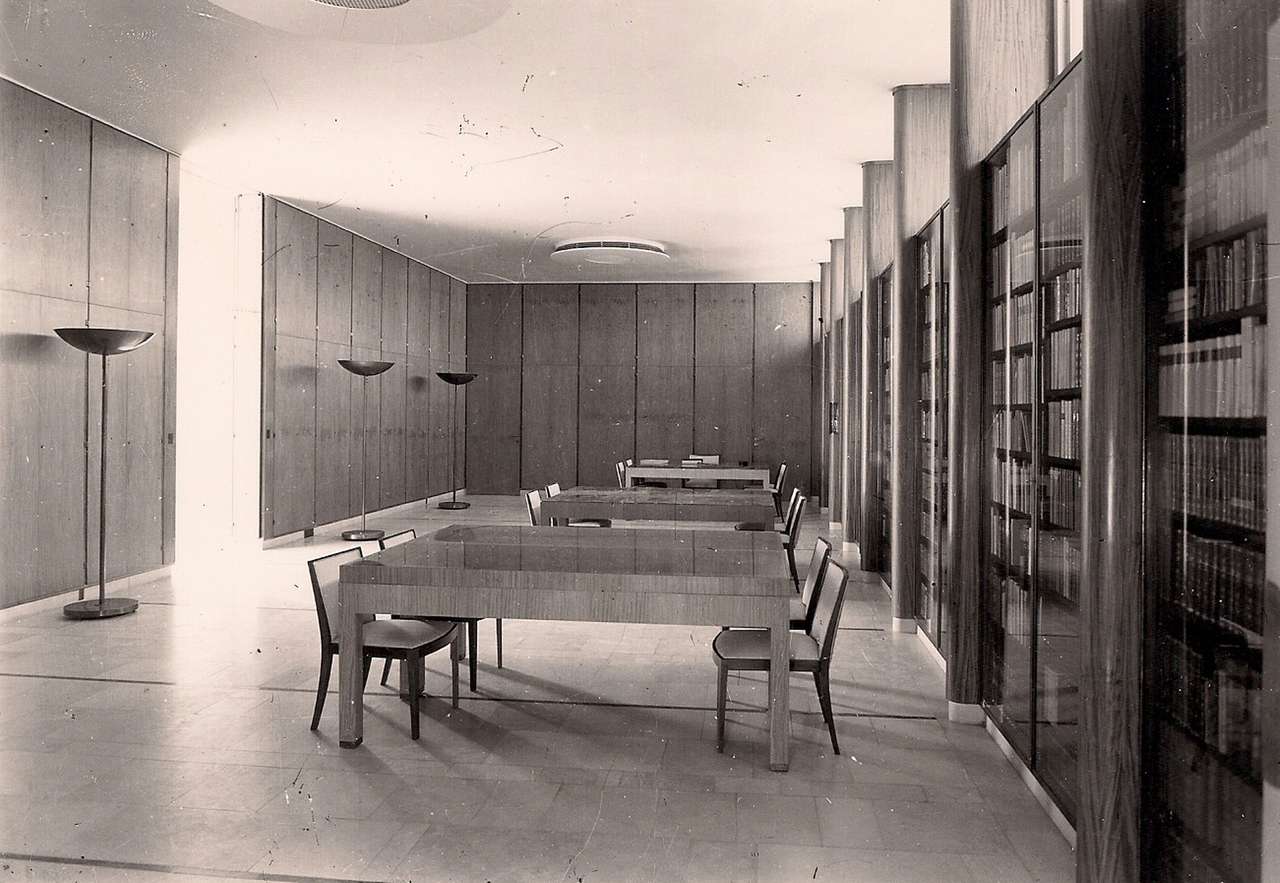
Fig. 2: The large reading room and lecture hall on the top floor of the Schocken Library, photographed by Alfred Bernheim around 1938; Israel Museum, Jerusalem.
Rehavia’s streets and alleys bear the names of renowned Jewish scholars of the Middle Ages: Ramban, Ben Maimon, Alharizi, Yehuda Halevi, Abraham ibn Ezra, Saadia Gaon, Rashba, Abarbanel, and Shlomo ibn Gabirol. In the 1930s, a new generation of poets and thinkers settled here, including Gershom Scholem, Ernst Simon (1899–1988), Ludwig Strauss, Hugo Bergmann (1883–1975), and many more. They brought along their extensive private book collections and, in a sense, transformed this suburb of the Holy City into a single great library, of which the largest and most significant space was taken up by Schocken’s book collection. Endowed with overwhelmingly German-language works, the literary collections in Rehavia at the same time embodied the transposed memory of German-Jewish erudition. Nowhere else in the world is there presumably such a collection of first editions of Goethe and Heine per square meter.
Salman Schocken – Ein deutsches Leben. Unternehmer, Intellektueller, Büchermensch, Verleger, Mäzen, Ästhet. Film by Noemi Schory, 2021: https://www.kino-zeit.de/film-kritiken-trailer-streaming/schocken-ein-deutsches-leben-2021
EMA - Erich Mendelsohn Archive
Correspondence of Erich and Luise Mendelsohn 1910–1953: https://ema.smb.museum/en/home
This work is licensed under a Creative Commons Attribution - Non commercial - No Derivatives 4.0 International License. As long as the material is unedited and you give appropriate credit according to the Recommended Citation, you may reuse and redistribute it in any medium or format for non-commercial purposes.
Prof. Dr. Ita Heinze-Greenberg is an architectural historian and professor emerita at the Swiss Federal Institute of Technology (ETH) in Zurich, where she was a member of the Institute for the History and Theory of Architecture until 2019. She earned her doctorate with a dissertation examining Erich Mendelsohn’s architectural works in Mandatory Palestine. Over the years, she has conducted research and taught at several leading institutions, including the Faculty of Architecture and Urban Planning at the Technion in Haifa (1984–1998), the Bezalel Academy in Jerusalem (1993), and the Technical University of Munich (2008–2012). Her extensive publications focus on 19th- and 20th-century architecture, with particular attention to nation-building, identity construction, migration studies, and the oeuvre of Erich Mendelsohn. Her most recent book, published in 2023, is titled Zuflucht im Gelobten Land. Deutsch-jüdische Künstler, Architekten und Schriftsteller in Palästina/Israel.
Ita Heinze-Greenberg, An Architectural Object: The Schocken Library as Transposed Memory of German-Jewish Erudition in Jerusalem (translated by Tim Corbett), in: (Hi)stories of the German-Jewish Diaspora, May 08, 2025. <https://diaspora.jewish-history-online.net/article/gjd:article-6> [October 25, 2026].
 This work is licensed under a Creative Commons Attribution - Non commercial - No Derivatives 4.0 International License. As long as the material is unedited and you give appropriate credit according to the Recommended Citation, you may reuse and redistribute it in any medium or format for non-commercial purposes.