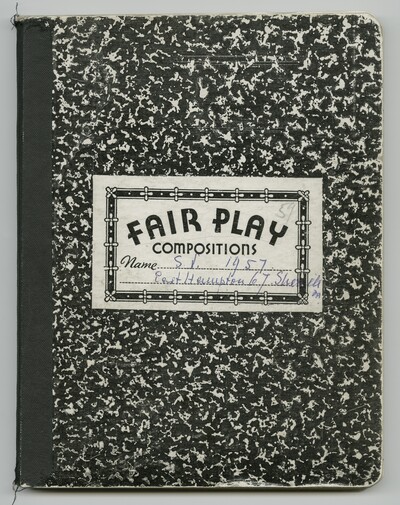
Keeping a diary from 1957 until 1969, the actress and screenwriter Salka Viertel (1889–1978) filled one notebook and nearly 400 typewritten pages. They are gathered together as four separate diaries in the collection of her papers held at the Deutsches Literaturarchiv (DLA) in Marbach. The first diary (28 June 1957 to 3 October 1958) is the only one to take the shape of a notebook, and the only handwritten document. Bound in cardboard, Viertel pencilled her initials, the year, and her address on the cover: “S.V. 1957, East Hampton 67 Sherrill Rd.” Inside the cover, the booklet contains a blank school timetable as well as lists of principal holidays and time differences, suggesting it was originally intended as a student diary.
The second diary (14 June 1959 to 12 January 1960) consists of 55 typewritten pages with some corrections by hand. This is also the case for the remaining two diaries, which run from 13 January 1960 to 15 June 1961 (82 pages) and from 24 June 1961 to 13 August 1969 (252 pages). Viertel kept her diary in English, although the entries are interspersed with German and, less often, phrases from other languages. Chronicling Viertel’s diasporic life – including reflections on her transnational family and circle of friends, her work, and her memories of the past – her diary provides an important first-person perspective on the history of the German-speaking Jewish diaspora.
Starting at the age of 68 in 1957, Salka Viertel began keeping a diary surprisingly late in life. However, she had a concrete objective in doing so: to practise personal writing in English in view of a memoir which she intended to orient principally towards an American readership. Having spoken German, French, and Polish with her family and her governesses, and Russian and Ukrainian with others during her childhood in Galicia before the First World War, Viertel had lived between languages from an early age. She began her professional life as an actress in German-language theatre, a career that spanned the years 1910 to 1928.
Despite learning English only after her emigration to Hollywood with her husband, the Austrian writer and director Berthold Viertel (1885–1953), in 1928, her second career as an English-language screenwriter was even more successful. While Viertel claimed to find writing in English easier than in German, her diary reflects that developing a personal autobiographical voice in a third language was an active and sometimes fraught process for her. Viertel’s decision to write her memoir in English seems to have been partly motivated by her wish to leave a testimony of her life for her three sons, to whom she eventually dedicated the memoir, and her grandchildren. They had all grown up in the United States and, like many descendants of German-speaking immigrants, had little or no command of German.
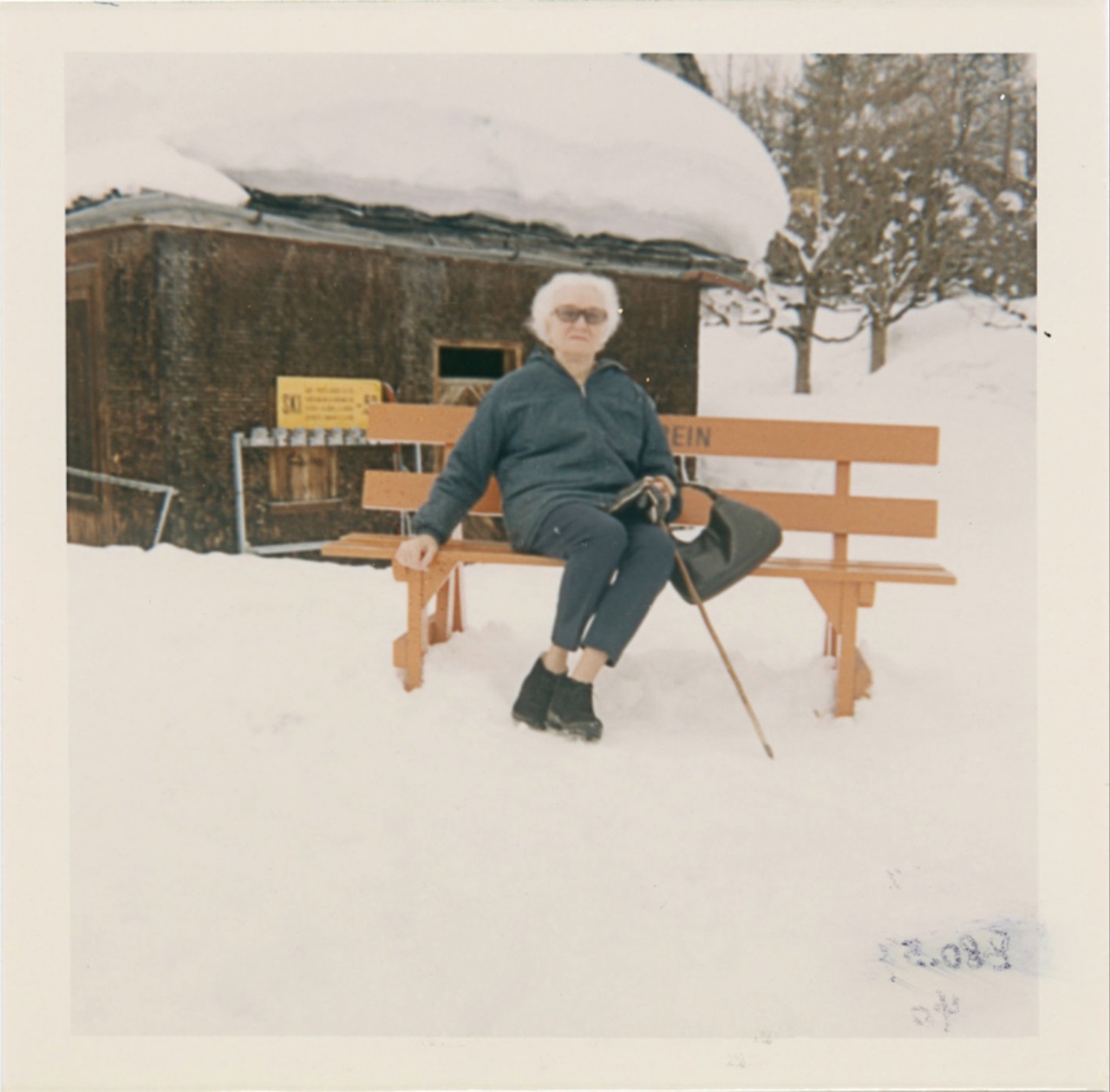
Fig. 1: Salka Viertel in Klosters, Switzerland, around 1960; Deutsches Literaturarchiv Marbach, B 80.57/41; B 2010.Z.004 (5230-64), © unknown.
While Salka Viertel had resolved to write a memoir as early as 1947 and had begun keeping her diary when she was still living in the United States, the bulk of both her diary and memoir was written after her relocation to Klosters in Switzerland in 1960. Viertel chose this mountain village in the predominantly German-speaking canton Graubünden principally because her son, the screenwriter and author Peter Viertel (1920–2007), spent part of his year there with his second wife, the British actress Deborah Kerr (1921–2007), and Viertel’s beloved granddaughter Christine. Klosters also attracted many other international artists and writers, such as Viertel’s close friends Greta Garbo (1905–1990) and Irwin Shaw (1913–1984), leading Peter Viertel to describe it as “Hollywood on the Rocks” in his memoir. More broadly, however, the German-speaking regions of Switzerland functioned as an important intermediary space for the German-Jewish diaspora in the post-war period, enabling a return to the language without requiring a physical return to Germany or Austria.
Viertel’s move to German-speaking Klosters led her to reflect on linguistic matters in her diary. Occasionally, she pondered the meaning of German after the caesura of her emigration. More often, however, she was concerned with practical and stylistic questions. The diary records the books that Viertel read in English in order to improve her style. It also reflects how she continually scrutinized her current usage of the language while writing her memoir. On 31 July 1960, for instance, she noted: “I have nothing to read, which is terrible. I could read some German books which are in the apartment, but it is very bad for me when I have to write English.” All quotes are taken from Viertel’s unpublished diaries held at the DLA Marbach (A: Viertel).
Viertel particularly grappled with having learnt English without much formal instruction: “[…] this is the terrible handicap when one has learned a language by ear. I have to avoid clichés more than anybody else” (21 March 1962). She conceived of her writing practice as a process of translation: “The first sentences I put on paper are always horrible, but then, once I said what I wanted to say, I can ‘translate’ it into quite decent English” (3 February 1963).
Other passages allude to the broader challenge of making herself understood by a target audience from a different language background and, concomitantly, a different cultural sphere. Having recently started dictating passages to a young Englishwoman, Viertel observed: “It was difficult for me to dictate to this little English girl so utterly from another world.” (4 August 1960).
These problems of transcultural communication aside, the question of how to represent a life that had transgressed languages in a memoir principally written in English continued to occupy her, as an entry from 3 May 1963 shows: “I read Orwell’s Politics and the English Language and it made me very language conscious. Especially what he says about the usage of un-English words. […] [I]t makes me hesitate now much more before I decide which word to use, f.e. Reinhardt’s performances, so that it does not sound hackneyed and worn out”.
The Austrian-born Max Reinhardt (1873–1943) was one of the most respected and internationally influential European theatre directors; Viertel had had minor parts on the Reinhardt-Bühnen in Berlin between 1911 and 1913. Having also found refuge in the United States, he continued working as a film director in Hollywood, which had brought him into closer contact with Viertel.
Next to reflecting Viertel’s grappling with language considerations in view of her memoir, her diary is in itself a rich source of insights into the practice of diasporic translingual memoir writing. More unfiltered and intimate than the memoir, Viertel’s diary contains occasional slippages from English into German that underline how closely language and emotion were intertwined for her.
An entry from 24 June 1961 demonstrates how describing the contents of an affectively charged letter she had received lead her to switch to German mid-sentence. Having just learnt from the letter by her youngest son’s therapist that Thomas Viertel (1925–2009) was intending to quit his studies, Viertel summarized the message thus: “[Thomas’s therapist is] writing to Peter to get Tom a job in the movies […] wo er sich nicht nur betaetigen kann[,] sondern auch wirklich etwas leisten kann[,] so dass sich sein Selbstgefühl hebt. Wenn so etwas nicht geschieht[,] wird er mehr und mehr herunterkommen. For a woman whose profession it is to know human souls, this is quite a remarkable letter” “[Thomas’s therapist is] writing to Peter to get Tom a job in the movies which will not only keep him occupied, but will in fact enable him to achieve something, so that his self-esteem improves. If this does not happen, he will go to seed more and more.” (translation by the author) (24 June 1961).
Clearly distraught by the news from California, Viertel oscillated between English and German, mixing language elements and including a full sentence in German before switching back to English. Occasions such as these are rare in her diary. However, there is another passage that amalgamates conscious linguistic reflection and an emotionally charged moment. Remembering her late former husband’s poetry, Viertel noted: “Still, my heart is not as strong as it was. I know that: Die heisse Flut rollt vor und grollt empor / Bis dies Dein Herz, versengte Kammer, bricht – Sometimes I think I love the German language only because of Berthold’s sonnets and letters. How I regret that I have not told him that before he died.” “Still, my heart is not as strong as it was. I know that: The hot flood rolls forward and roars upwards / Until it breaks your heart, scorched chamber – Sometimes I think I love the German language only because of Berthold’s sonnets and letters.” (translation by the author) (12 February 1963).
Quoting a poem by her ex-husband, who had passed away ten years earlier, in 1953, and who had never adapted to writing in English as much as herself, Viertel surprisingly asserted that she “love[s]” the German language – because of his oeuvre. Still, she switched back to English for her own account.
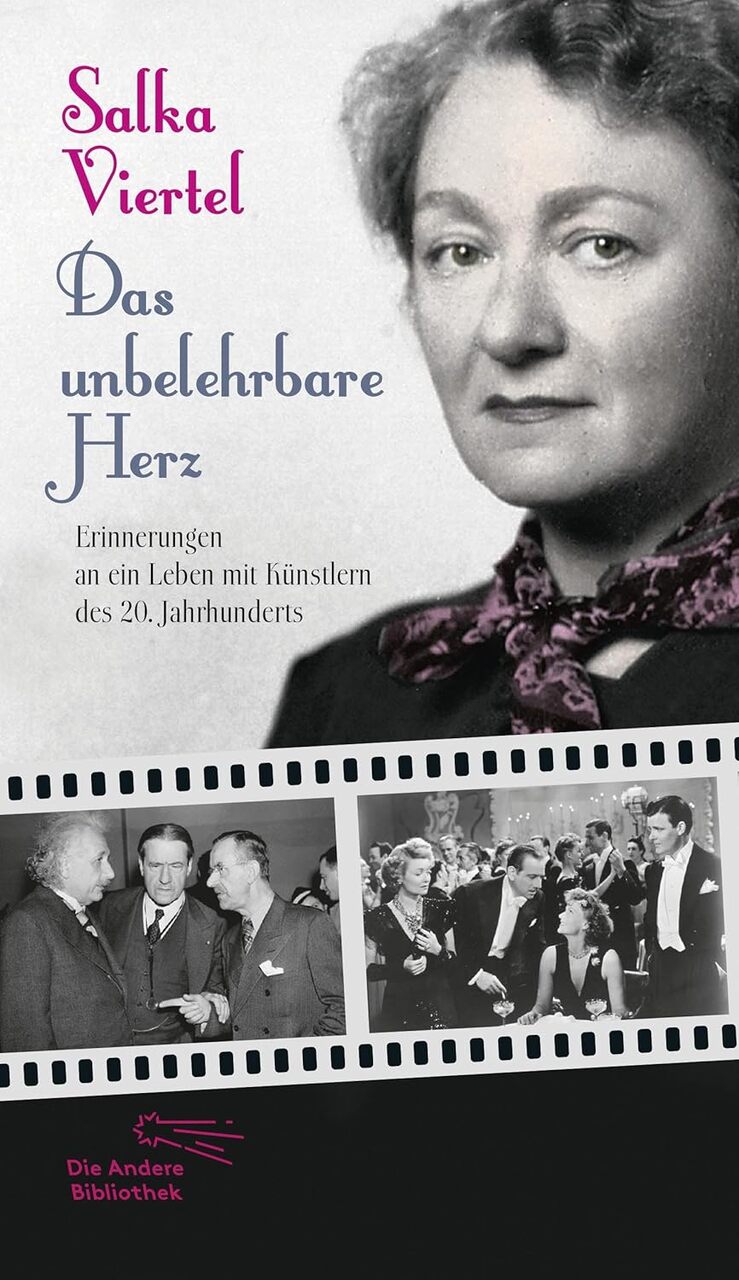
Fig. 2: Salka Viertel’s German version of her memoir, published in 2012 as Das unbelehrbare Herz: Erinnerungen an ein Leben mit Künstlern des 20. Jahrhunderts; © Die Andere Bibliothek, Aufbau Verlag.
Although it had served as a vehicle for deeply personal reflections on her diasporic life, identity, and languages, Viertel brought her diary to a close in August 1969, shortly after the publication of her English-language memoir, The Kindness of Strangers. This suggests that her diary practice remained primarily tied to her original motivation of using it as a linguistic ‘testing ground’ for her personal autobiographical voice in English. While Viertel was still fluent in German, as her letters show, she largely entrusted the production of the German version of her memoir to a professional translator: published in 1970 as Das unbelehrbare Herz: Ein Leben in der Welt des Theaters, der Literatur und des Films, it was labelled „Von der Autorin bearbeitete Übersetzung aus dem Amerikanischen von Helmut Degner“ („Translation from American English by Helmut Degner, revised by the author“), illustrating the distance from the German language that she had retained even in German-speaking Switzerland. Thus, Salka Viertel’s diaries provide a unique perspective on language, memory, and displacement, and illustrate how German-speaking Jews in the twentieth century used language to bridge their origins with new realities.
Carola Bebermeier, “‘Sundays at Salka’s’—Salka Viertel’s Los Angeles Salon as a Space of (Music-)Cultural Translation,” Musicologica Austriaca: Journal for Austrian Music Studies, Version 1.0, June 21, 2021; https://musau.org/parts/neue-article-page/view/113.
Shira Brisman, “Salka Viertel 1889–1978”, in: The Shalvi/Hyman Encyclopedia of Jewish Women; https://jwa.org/encyclopedia/article/viertel-salka.
Remembering The Exiles: Salka Viertel. A reading and discussion with Salka Viertel’s biographer Donna Rifkind, Exile Studies Librarian Michaela Ullmann, and Friedel Schmoranzer, Head of Fellowship Programs at Villa Aurora, 2021: www.youtube.com/watch?v=07md9fFVSuo.
„Salka Viertel“, in: Wien Geschichte Wiki; www.geschichtewiki.wien.gv.at/Salka_Viertel.
This work is licensed under a Creative Commons Attribution - Non commercial - No Derivatives 4.0 International License. As long as the material is unedited and you give appropriate credit according to the Recommended Citation, you may reuse and redistribute it in any medium or format for non-commercial purposes.
Anna Marion Weber is a PhD candidate in German literature at King’s College London and jointly at the University of Stuttgart. Her research focuses on German-Jewish women’s life writing in exile in the English-speaking world, with a special interest in the work of Salka Viertel, Vicki Baum, Gabriele Tergit and Gina Kaus. She has taught seminars on German-Jewish literature, exile literature, and women’s writing in the twentieth century. She has contributed articles on Gabriele Tergit to the volume Chronistin und Kritikerin der Moderne (Exil-Kulturen 8, J.B. Metzler, 2024) and to the Friends of Germanic Studies Newsletter (ICLS London, 2025); publications on Salka Viertel are forthcoming. In 2025, she gave the annual Sylvia Naish Lecture at the University of London. Anna is an alumna of the German Academic Scholarship Foundation’s Leo Baeck Fellowship programme.
Anna Marion Weber, Living between Languages, Writing between Languages: Salka Viertel’s Diaspora Diary, in: (Hi)stories of the German-Jewish Diaspora, July 31, 2026. <https://diaspora.jewish-history-online.net/article/gjd:article-59> [September 15, 2026].
 This work is licensed under a Creative Commons Attribution - Non commercial - No Derivatives 4.0 International License. As long as the material is unedited and you give appropriate credit according to the Recommended Citation, you may reuse and redistribute it in any medium or format for non-commercial purposes.