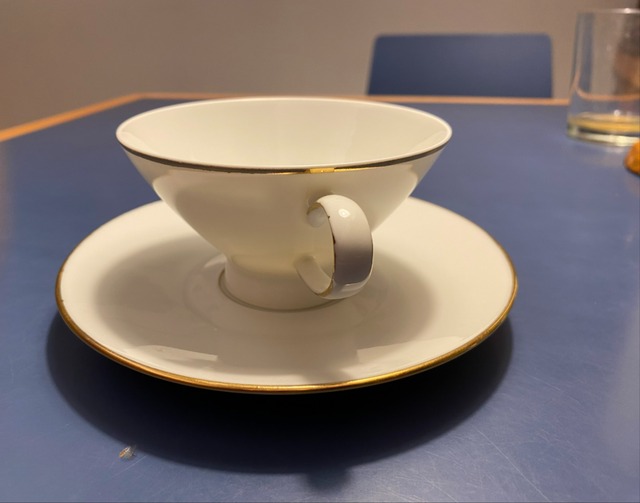
The photo shows a porcelain cup of the famous German company Rosenthal, a traditional brand that has been known since the late nineteenth century for its high-quality porcelain, glass, and ceramic products. In the picture, the cup is sitting on the dining table in the Jerusalem apartment of David Heyd (born 1945), a professor emeritus of philosophy at the Hebrew University. Heyd belongs to the second generation of Shoah survivors in Israel. His father, Hans Heydt (1913–1968), fled Nazi Germany in the spring of 1934, traveling from his home city Cologne via Italy to Jerusalem. He was later followed there by his mother, Bertha Heydt, née Levy (1892–1975), and his sister Liese Heydt (1921–1988).
Before fleeing, Bertha Heydt had consigned all of her home furnishings to a Cologne-based removals company for transportation to British Mandatory Palestine, including the coffee set and many other familiar pieces of furniture and household items belonging to the family. Although employees of the removals company stole the family silver and other valuables from the waiting container before its transportation, the Rosenthal coffee set reached its destination along with the rest of the cargo unscathed.
This is how the remaining belongings of the family made their way from Cologne to Bertha Heydt’s new apartment in Jerusalem and later also partly to the apartments of her children and grandchildren. Her grandson David Heyd received the coffee set along with some champagne flutes, a floor lamp, a desk, and a cupboard. The cups, glassware, and furniture form a symbolic bridge across the painful ruptures that Nazi persecution and the Shoah inflicted on the family’s biography. The conscious use of these objects allows the Heyd family to maintain the memory of their German-Jewish past to this day, even if they have long since regarded themselves as an Israeli family.
The pictured coffee cup is a source of material culture. It stands for many other household items that belonged to the everyday life of Jewish families in Germany. Extensive inventories listing complete home furnishings down to the last detail can be found in many case files from postwar restitution processes. These lists offer insights into the domestic and everyday culture of German-Jewish families before the Shoah. In many cases, the home furnishings enumerated in these lists had to be left behind or were expropriated and irretrievably lost. In other cases – like that of Bertha Heydt – the refugees were able to save these objects.
Familiar objects like the Rosenthal coffee set accompanied their owners when they arrived in new, initially unfamiliar surroundings. Here, they not only served practical purposes; they were also charged with meanings, memories, and emotions. Historicizing such objects sheds fresh light on the relationships between material culture, migration history, and everyday culture in the German-Jewish diaspora.
The Rosenthal coffee set reflected the high standard of living that the Heydt family had enjoyed in their former home city, Cologne. The family had lived in the Rhineland for centuries and was well established long before the Nazis came to power in 1933. Together with the related Voss family, which was also Jewish and also belonged to Cologne’s economic bourgeoisie, the Heydts owned a successful factory producing shoe polish and floor wax in Cologne’s Nippes district. After her husband, Max Heydt (1882–1926), died from the long-term effects of his wartime injuries, Bertha Heydt ran her family’s side of the joint venture from the mid-1920s onward, and did so with great efficiency. As befitted her class, she lived with her children, Hans and Liese Heydt, in a generous, late-nineteenth-century, raised ground-floor apartment in Cologne’s Agnesviertel district. The family employed its own cook and chauffeur.
In Cologne, the Heydts stood for educated, middle-class, liberal, and secular values and – like most Jewish families – were deeply rooted in German society. They spoke German at home, the children attended municipal schools, and many males in the family, like Max Heydt, had participated in the First World War, some of them even in combat roles. At the same time, the Heydts cultivated a Jewish identity. All members of the extended family who got married in Germany married a Jewish partner. The close family relationship was also evident in the fact that several generations of the Heydt and Voss families lived within just a few minutes’ walking distance from each other in a small area of Cologne’s Agnesviertel district.
The families were uprooted from their lives in Cologne when the Nazi persecution began. Bertha Heydt’s son Hans, who was forced to abandon his studies at Cologne University after the summer term of 1933, was one of the first to leave Germany. In February 1934, he emigrated to British Mandatory Palestine, motivated among other things by his sympathies for the Zionist movement, whose adherents advocated for a ‘Jewish homeland’ in Palestine. Bertha Heydt initially remained in Cologne and continued running the family business until the increasing pressure of ‘Aryanizations’ forced her to sell the factory far below its value in the summer of 1938. That same year, her son returned to his home town one last time on a British mandatory passport, probably also using this visit to urge his mother and sister to emigrate. During this same visit, he went to a photo studio in Cologne to have his picture taken with a confident smile on this face.
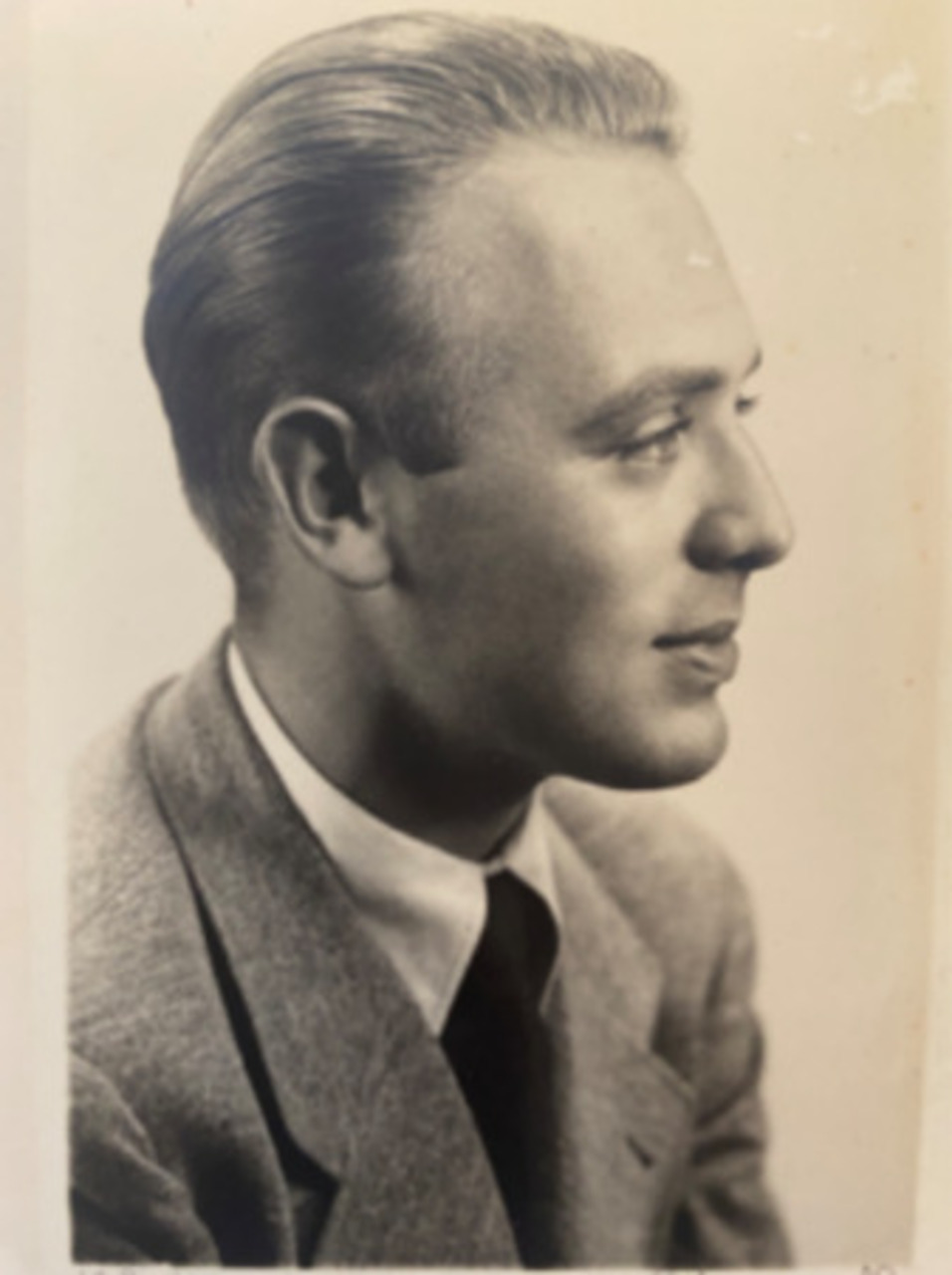
Fig. 1: Hans Heydt (later: Uriel Heyd) during his last visit to Cologne, 1938; private archive of David Heyd.
In December 1938, just a few weeks after the November Pogroms, Bertha and Liese Heydt finally emigrated to Palestine. Other relatives were able to flee to South Africa, the United Kingdom, and the United States, but several family members were not able to escape. They were murdered in Auschwitz and other Nazi concentration camps.
Some refugees continued to suffer in exile from the long-term effects of the persecution. Among them was Hans Heydt’s cousin Anneliese Heydt (1925–1967), who had fled to England on one of the last ‘Kindertransporte’ in August 1939 as a penniless fourteen-year-old. Unlike her parents, who fell victim to Nazi persecution, she found refuge there along with some 10,000 other Jewish children and teenagers. Yet Anneliese Heydt suffered repeated breakdowns in her new home city, London, and had to undergo psychiatric treatment and repeated hospitalization. Several medical reports diagnosed her with depression, which they attributed to the impact of her persecution. Her obvious trauma led to severe psychological and physical disabilities and presumably contributed to her early death at only 42 years of age.
Their arrival in foreign environments presented refugees with manifold challenges. Those who had lived through traumatic experiences, like Anneliese Heydt, had an especially hard time. The refugees’ social, cultural, and economic capital determined the subsequent course of their lives. The highly talented Hans Heydt, for example, who had been endowed with sufficient means by his wealthy mother, managed very quickly to perfect his Hebrew, as he had already begun learning the language as a teenager. He had been assisted in this endeavor by the closeness to his uncle Kurt Levy (1907–1935), an outstanding young linguist and Hebrew expert at Bonn University, who was driven to suicide by Nazi persecution. While most German Jews had trouble learning this language, Heydt was already able to commence new studies at the Hebrew University in Jerusalem in the 1934/35 academic year.
Although his mother, Bertha Heydt, was subject to persecution in Nazi Germany for a much longer period and expressed shock at her experiences after her escape, she also managed to get settled relatively quickly. This is evident from a letter she wrote to an acquaintance in Cologne in February 1939, shortly after her arrival in Palestine. In the letter, Bertha Heydt first mentioned a “sudden bereavement” in her family that had affected her “very deeply” – her brother-in-law had “died quite unexpectedly in a concentration camp” not long before her departure. Otherwise, her account about the “very interesting life and goings-on” in Palestine sounded positive: “I have in the meantime recovered somewhat from the many disturbances and shocks of the past months and am slowly beginning to settle down in this peculiar and beautiful country, which will hopefully become a happy homestead for us.” Letter from Bertha Heydt to Walter Thiel, Feb. 15, 1939; Landesarchiv NRW, Rep 266, Nr. 3981, Bl. 84.
Persecution and flight were initially followed in Palestine by downward social mobility. The Nazis had robbed the Heydt family of almost all their assets, following the usual patterns. These assets had included extensive security portfolios, bank deposits, properties, and, not least of all, the family business. In place of the generous apartment in Cologne’s Agnesviertel district, Bertha Heydt now had to content herself with a small two-room apartment in Jerusalem. Despite these unfamiliar and difficult circumstances, she managed to start a new life. She learned Hebrew, embarked on a career as a civil servant and found employment in a government ministry.
Following the foundation of the State of Israel in 1948 and of the Federal Republic of Germany in 1949, Bertha and Hans Heydt managed to push through numerous restitution claims in West German compensation courts. Such restitution processes often placed a significant emotional burden on the victims: In many cases, they dragged on for years, so that the families had to engage with German bureaucrats, some of whom had served in the Nazi regime and often tried to deliberately obstruct the procedures. By the mid-1950s, the Heydt family won compensation for some of their stolen assets and were thus able to partially restore their bourgeois status.
The Heydts eventually transformed from a family of German entrepreneurs into an Israeli family of academics. Hans Heydt embarked on a career at the Hebrew University as an internationally renowned historian and orientalist. His two sons, Michael (1943–2014) and David Heyd, also became professors in Jerusalem, while his daughter, Ofra Heyd (born 1953), became a successful psychologist. Meanwhile, their aunt Liese Heydt initially worked as a teacher for a few years until she completed her studies in educational research and became an academic at Haifa University. Academic careers also predominated in subsequent generations.
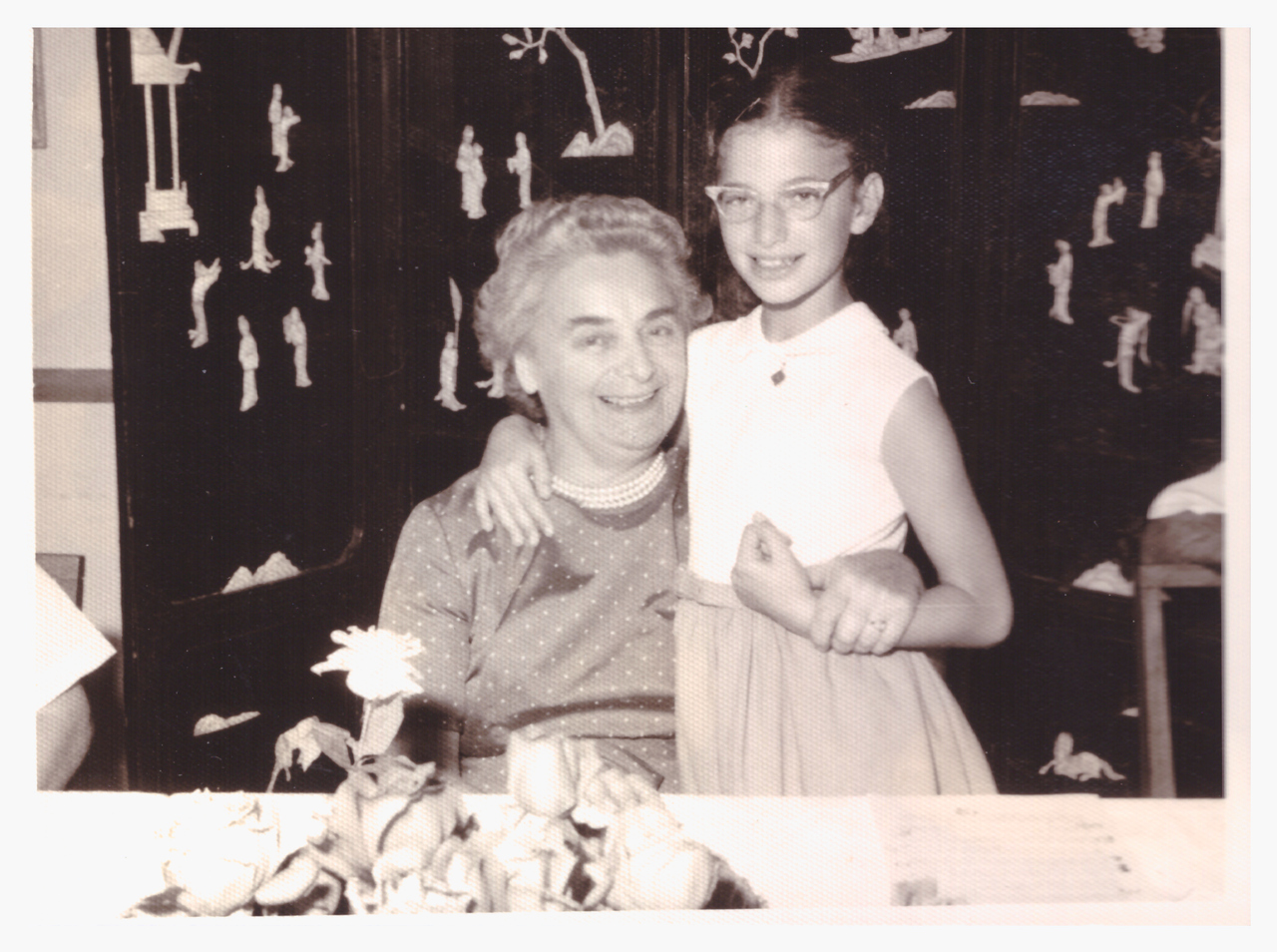
Fig. 2: Bertha Heydt on her seventieth birthday together with her granddaughter Ofra Heyd, 1962; private archive of David Heyd.
Within one generation, the Heydt family adopted a new, Israeli identity. Shortly after his arrival in Palestine, Hans Heydt changed his German name into a Hebrew form and henceforth called himself Uriel Heyd. Also, his sister Liese Heydt renounced her German given name and adopted the name Hava. The Hebraization of German names was a very common practice, signifying an affirmation of Zionism and a distancing from all things German. Accordingly, Uriel Heyd and his wife Rose Heyd, née Seligsohn (1913–1996), who was also of German-Jewish origin, decided never to speak German with their children so that the language of the perpetrators, which was scorned in Israel, would not survive within their family.
Uriel Heyd set a conscious example through his identification with Zionism and later with the State of Israel. His Zionist convictions inspired his commitment to contribute to the new Jewish state. In the 1940s, he was active in the Jewish Agency (JA) and served as a diplomat before beginning his academic career at the university in Jerusalem. He looked to the future and was determined to leave the past behind, as his son David Heyd recalled. Uriel Heyd hardly ever spoke with his family about the Shoah and the fate of their murdered or expelled relatives. Neither he nor his son Michael engaged in their professional lives as historians with the history of the Shoah, but rather specialized in other fields and eras. Yet Uriel Heyd maintained his connections to his former Cologne-based family. In the postwar era, he was in contact, among others, with two aunts who had fled to the United States, while contact with other relatives who had fled to South Africa, the United States, and the United Kingdom broke off. Heyd preserved the family archive containing many documents and photos, but after his own emigration, he discontinued his genealogical work on a family tree that he had created on the basis of painstaking research as a young man in Cologne.
Over time, other family members and wider developments offered further impulses to engage with the family’s German-Jewish history and the Shoah. The Eichmann trial in particular, which took place in Jerusalem from April to December 1961, sparked discussions not only within the Heyd family but within Israeli society as a whole. Since the 1960s and 1970s, the Shoah has become ever more present in Israeli public life, politics, and media. The developing national remembrance culture furthered interest among many families in their own histories, including in the Heyd family.
Family history ultimately also remained present in the form of everyday objects from the former homeland. Bertha Heydt’s Jerusalem apartment was equipped, among other things, with glassware and dishes from Cologne as well as a bookshelf containing German special editions of Goethe and Schiller. As David Heyd recalled, his grandmother regularly met up with a sister-in-law from Cologne who had also fled to Jerusalem and lived only some 200 meters away. Every Friday, the two women celebrated a weekly teatime with elegant clothes and home-baked cake. On these occasions, they would always speak German, not least of all because the sister-in-law did not speak Hebrew. When these teatimes took place in Bertha Heydt’s apartment, she made use of the family’s Rosenthal set. There, it served as a link between the past and the present. The aesthetics and symbolism of these objects would later also be appreciated by David Heyd and his family. Regarding the set and other objects left by his grandmother, he writes: “They are beautiful, and we love the sense of continuity they give us.” Email from David Heyd to the author, Feb. 26, 2024.
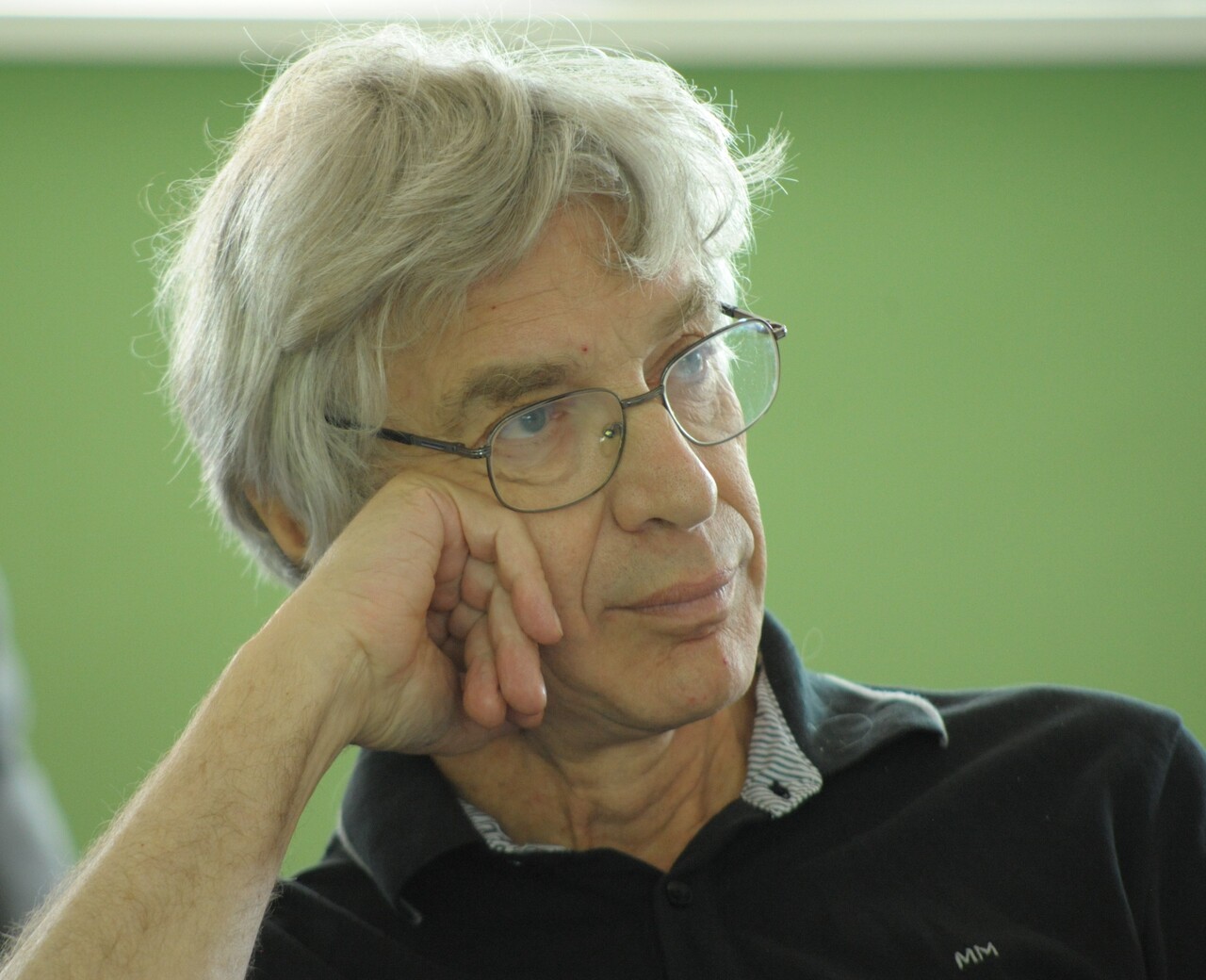
Fig. 3: David Heyd at an academic conference in Zagreb, 2015; private archive of David Heyd.
The functions and meanings of the representative Rosenthal set, and the practices associated with it, changed over time. Before the Nazi persecution and expulsion from Germany, it symbolized the high social status of a wealthy businessowner family from Cologne. It served the family in their everyday life to maintain their bourgeois habits through conventional practices such as dignified gatherings for tea or coffee. In the German-Jewish diaspora, the resumption of such bourgeois rituals endowed the objects with a new significance: By using these objects, a part of the family’s former identity could be preserved, while its members – like many other German Jews in Palestine and Israel – underwent processes of social, cultural, and political transformation.
In later phases of Israeli remembrance culture, these objects were endowed with additional levels of meaning. This became evident at the latest when David Heyd himself began in the 2010s to research his family’s history. By this time, the cups were no longer associated only with the Heydt family’s fate in Nazi Germany. The objects now stand for the entire family history spanning several centuries in centuries in Germany, which Heyd’s father had traced back to the eighteenth century in the course of his genealogical research based on Torah wimpels and other documents. The extent to which the objects of the Rosenthal set will continue to be passed down to subsequent generations and used by them raises questions about intergenerational commemorative cultures in the second, third, and fourth generations of Shoah survivors.
This work is licensed under a Creative Commons Attribution - Non commercial - No Derivatives 4.0 International License. As long as the material is unedited and you give appropriate credit according to the Recommended Citation, you may reuse and redistribute it in any medium or format for non-commercial purposes.
Felix Römer is a Privatdozent and Heisenberg Fellow at the Institute of History at Humboldt University in Berlin. His research focuses on Nazi history as well as British, German, and European history after 1945. His books include Der Kommissarbefehl: Wehrmacht und NS-Verbrechen an der Ostfront 1941/42 (Paderborn, 2008), Kameraden: Die Wehrmacht von innen (München, 2012) and Inequality Knowledge: The Making of the Numbers about the Gap between Rich and Poor in Contemporary Britain (Boston/Berlin 2023).
Felix Römer, Objects of Memory: The Heyd(t) Family’s Rosenthal Coffee Set (translated by Tim Corbett), in: (Hi)stories of the German-Jewish Diaspora, November 03, 2025. <https://diaspora.jewish-history-online.net/article/gjd:article-45> [September 30, 2026].
 This work is licensed under a Creative Commons Attribution - Non commercial - No Derivatives 4.0 International License. As long as the material is unedited and you give appropriate credit according to the Recommended Citation, you may reuse and redistribute it in any medium or format for non-commercial purposes.