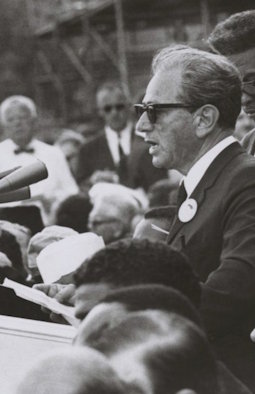
The March on Washington for Jobs and Freedom took place in front of the Lincoln Memorial in the American capital on 28 August 1963. With around 250,000 participants, this was the biggest demonstration in the history of the United States up to that point. The March on Washington is today known above all for the iconic speech held by the American pastor and civil rights activist Martin Luther King Jr. (1929–1968), in which he spoke about his dream of a just society without racist discrimination. This impressive gathering, along with its moving speeches, contributed significantly to the elimination of racial segregation through the Civil Rights Act of 1964 and Voting Rights Act of 1965.
Immediately before King’s speech on that occasion, the American rabbi Joachim Prinz (1902–1988) from Newark, New Jersey, also addressed the crowd, among whom were tens of thousands of Jews. In his rousing speech, he explained why the Jewish community was committed to the struggle for civil rights. Precisely due to the experience of millennia of Jewish history, Prinz argued, the community was able to identify completely with the suffering and the history of the African American community.
Yet Prinz himself also had a personal connection to the civil rights movement based on his own experience. He had been a rabbi in Berlin in the 1930s before being forced to flee Germany by the Nazis in 1937. During these years, as he elaborated, he had learned that the greatest problem was not the hate and oppression of a few, but rather the silence of the many. In conclusion, he demanded that the American self-conception as “the land of ‘liberty and justice for all’” should be made “a glorious, unshakeable reality in a morally renewed and united America.” With his speech at the March on Washington, Prinz managed to transpose the German-Jewish experience of antisemitic oppression and persecution by the Nazis onto the US context and to universalize it for the sake of a mutual struggle against racism.
It was no coincidence that tens of thousands of Jews participated in the March on Washington or that Rabbi Joachim Prinz held a prominent speech on behalf of the Jewish community of the United States. His speech was an expression of the legacy of a long tradition of political and legal cooperation between Jewish and African American groups reaching back to the American Civil War and the abolition of slavery in 1865. The Jewish and African American communities had begun politically organizing themselves more actively from the late nineteenth century onward – at first independently of one another, but increasingly also in unison. The two groups were united by similar experiences of exclusion and discrimination as well as by similar goals of political, social, and economic equality and participation.
In the course of the early twentieth century, Jewish organizations, but above all individuals, became the most important allies in the African American struggle for liberation. One example of this cooperation was the National Association for the Advancement of Colored People (NAACP), established in 1909, the first and for many decades the most important African American civil rights organization in the United States, which exists to this day. Jewish activists numbered among the central figures in its founding, so for example Anna Strunsky (1877–1964) and Henry Moskowitz (1880–1936). Due to anti-Jewish legislation, they had emigrated as minors from present-day Belarus and Romania to the United States. Jewish financiers provided the necessary funds, and a large portion of the organization’s leading members were Jewish, among others, the first two presidents, Joel Elias Spingarn (1875–1939) and his younger brother Arthur B. Spingarn (1878–1971). They were later supported by prominent individuals like the physicist and German-Jewish immigrant Albert Einstein (1879–1955) and the rabbi and Zionist Stephen S. Wise (1874–1949).
This cooperation intensified from the 1940s onward, especially after the end of the Second World War, due primarily to the fact that it henceforth became institutionalized on an organizational level and thus no longer relied on individual philanthropy. The most important Jewish organization in this context was the American Jewish Congress (AJCongress) founded in 1918, which was later followed by other organizations like the American Jewish Committee (AJC) and the Anti-Defamation League (ADL). Cooperation between these groups was underpinned by the idea that discrimination and segregation were structurally grounded in America’s majority society and thus impacted both the Jewish and the African American communities in similar ways. As the lawyer Shad Polier (1906–1976), one of the leading figures in the AJCongress, put it in 1949: “Sociologically it is plain that the difference between the segregation of Negroes and the persecution of Jews is only skin deep. […] It not always is the same race or creed which suffers abuse, but it is always the same threat hidden beneath this abuse.” Shad Polier, “For the Rights of all Men,” in: Congress Weekly, 14 November 1949, pp. 5-8, here p. 5.
On the basis of this standpoint, Jewish organizations participated with increasing intensity in the civil rights movement, which began in the mid-1950s and peaked in the 1960s. Jewish lawyers fought for the equal rights of all American citizens, Jewish organizations put pressure on the authorities, and Jewish activists were disproportionately involved in various acts of protest – so, for example, in the sit-ins beginning in Greensboro in 1960 and the Freedom Rides from 1961 onward, during which black and white people drove together on integrated buses in the southern states in order to challenge and bring down the system of so-called racial segregation.
About two thirds of the white people involved in the Freedom Rides were Jewish. The symbolic high point of this cooperation was Joachim Prinz’s appearance in the March on Washington in 1963 and the protest march from Selma to Montgomery in 1965, during which the Jewish theologian Joshua Heschel (1907–1972), who was born in Warsaw and driven out of Nazi Germany in 1938, demonstrated arm-in-arm in the first row with Martin Luther King. Another event that left a deep mark in Jewish-American memory was the murder of the three civil rights activists Michael Schwerner (1939–1964), Andrew Goodman (1943–1964), and James Chaney (1943–1964), two Jews and an African American, by a racist hit squad of the Ku Klux Klan in 1964.
The role played by German-Jewish immigrants in Jewish-African American relations is difficult to assess with certainty. Many surely abhorred racist segregation, which structurally reminded them of the exclusion practices of National Socialism. Yet those who did become active consisted primarily of individuals who had already held progressive views before their arrival in the United States. A personal history of persecution, thus, did not automatically inspire someone to participate in the struggle against segregation and racism. Nevertheless, the Shoah and the Second World War – especially the participation of African American GIs on the European battlefield and the flight of tens of thousands of Jews to the United States – made the two systems of discrimination, antisemitism and racism, appear comparable.
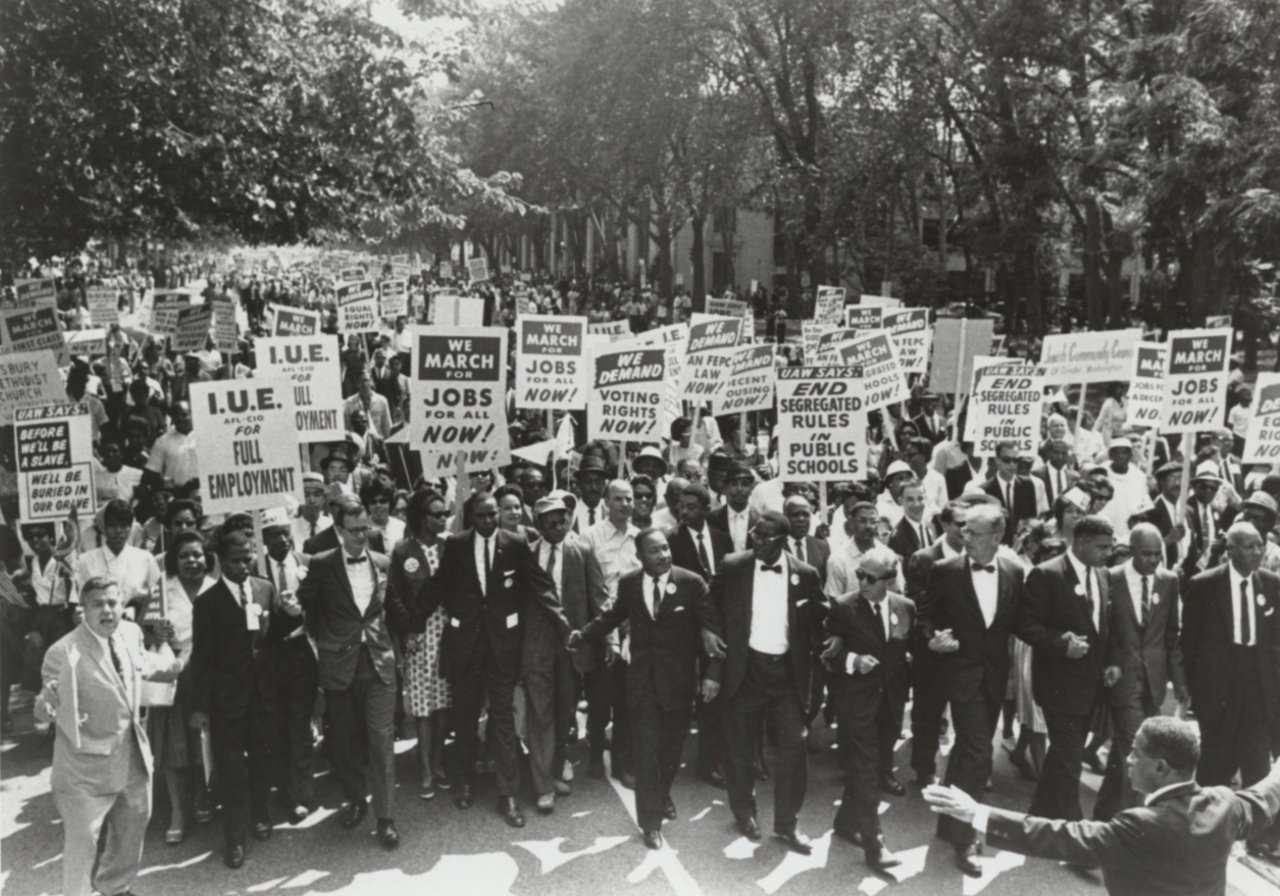
Fig. 1: Martin Luther King Jr. and Joachim Prinz during the “March on Washington for Jobs and Freedom,” Washington, D.C., 1963; photo reproduced with kind permission of the American Jewish Historical Society, New York. From the collections of the American Jewish Congress (I-77).
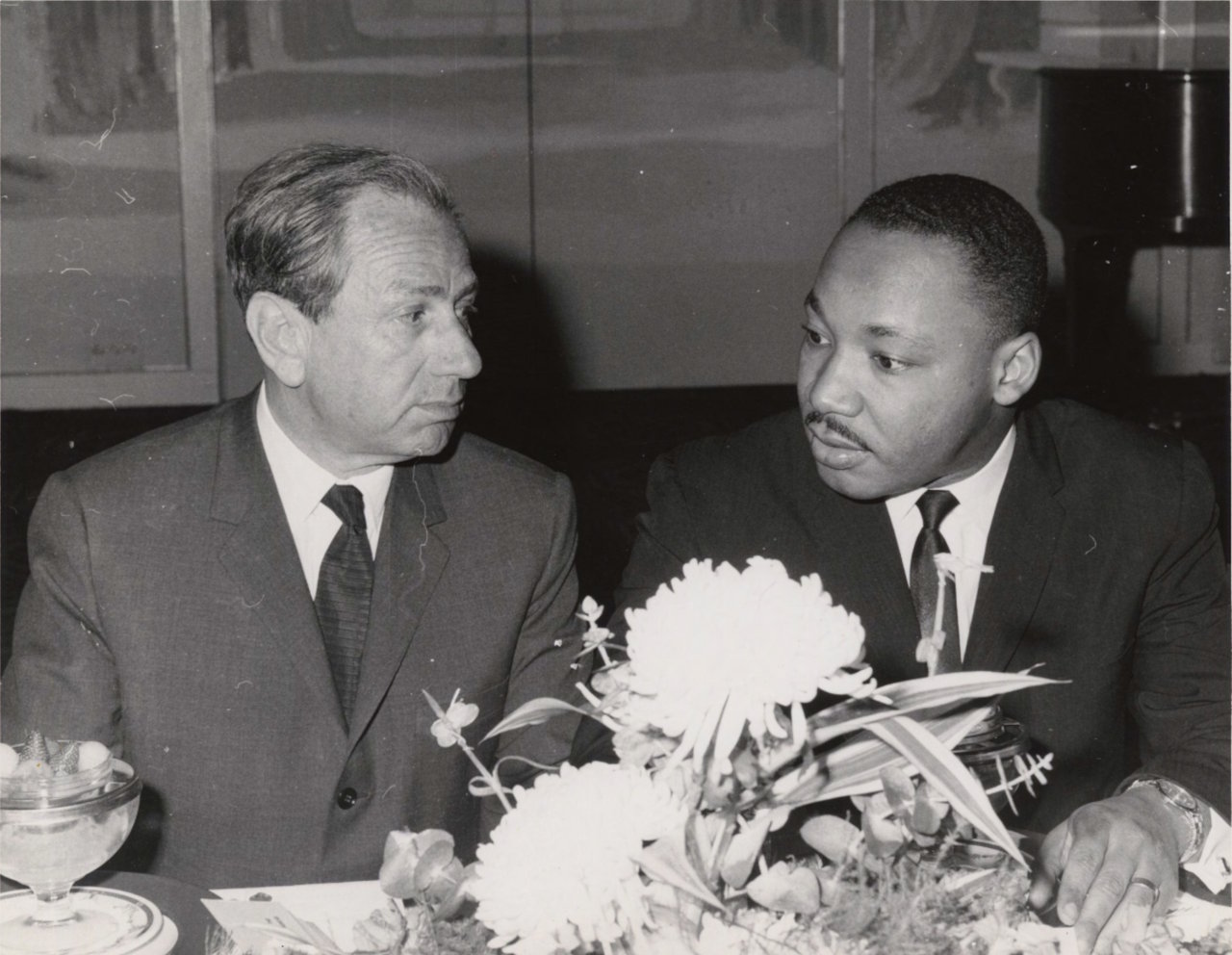
Fig. 2: Joachim Prinz and Martin Luther King Jr. at a fundraising dinner of the American Jewish Congress, 1963; photo reproduced with kind permission of the American Jewish Historical Society, New York. From the collections of the American Jewish Congress (I-77).
Consequently, when Joachim Prinz spoke on the steps of the Lincoln Memorial on 28 August 1963, this was in the first instance a representative expression of this long history of cooperation. Prinz had been serving as president of the AJCongress since 1958, and this function alone already made him one of the most important Jewish supporters of the civil rights movement. He therefore referred to various fundamental patterns underlying this cooperation, addressing that it was precisely the painful “historic experience of three and a half thousand years” that awakened a feeling of “complete identification and solidarity” with the African American community. Following from the politics of the preceding twenty years, Prinz framed the cooperation between the communities as a mutual struggle to realize the universal values of “liberty and justice for all” that underlay America’s self-conception – and not as the pursuit of particularist interests on behalf of ethnic or religious minorities. Prinz stated that the country “must speak up and act,” but “not for the sake of the black community but for the sake of the image, the idea and the aspiration of America itself.”
Yet Prinz did not just want to emphasize a general Jewish perspective, but also a personal one, drawing on his own biography. From 1927 to 1935, he had been a rabbi in Berlin and had stood up to daily denigration and oppression by the Nazi regime until his emigration in the summer of 1937. Beginning already shortly after his arrival in the United States, he had repeatedly emphasized that German Jews who had experienced Nazi discrimination perceived American racism differently, especially racist segregation. For Prinz, his specific German-Jewish experience honed his perspective on American society. Thus, he evoked this history on the steps of the Lincoln Memorial in order to share his most important insight from that period, namely that the greatest problem was not the “bigotry and hatred” of a few, but rather the silence of the masses. From a “great people which had created a great civilization,” the Germans “had become a nation of silent onlookers […] in the face of hate, in the face of brutality and in the face of mass murder.” According to Prinz, this experience gave rise to a responsibility: “America must not become a nation of onlookers. America must not remain silent.”
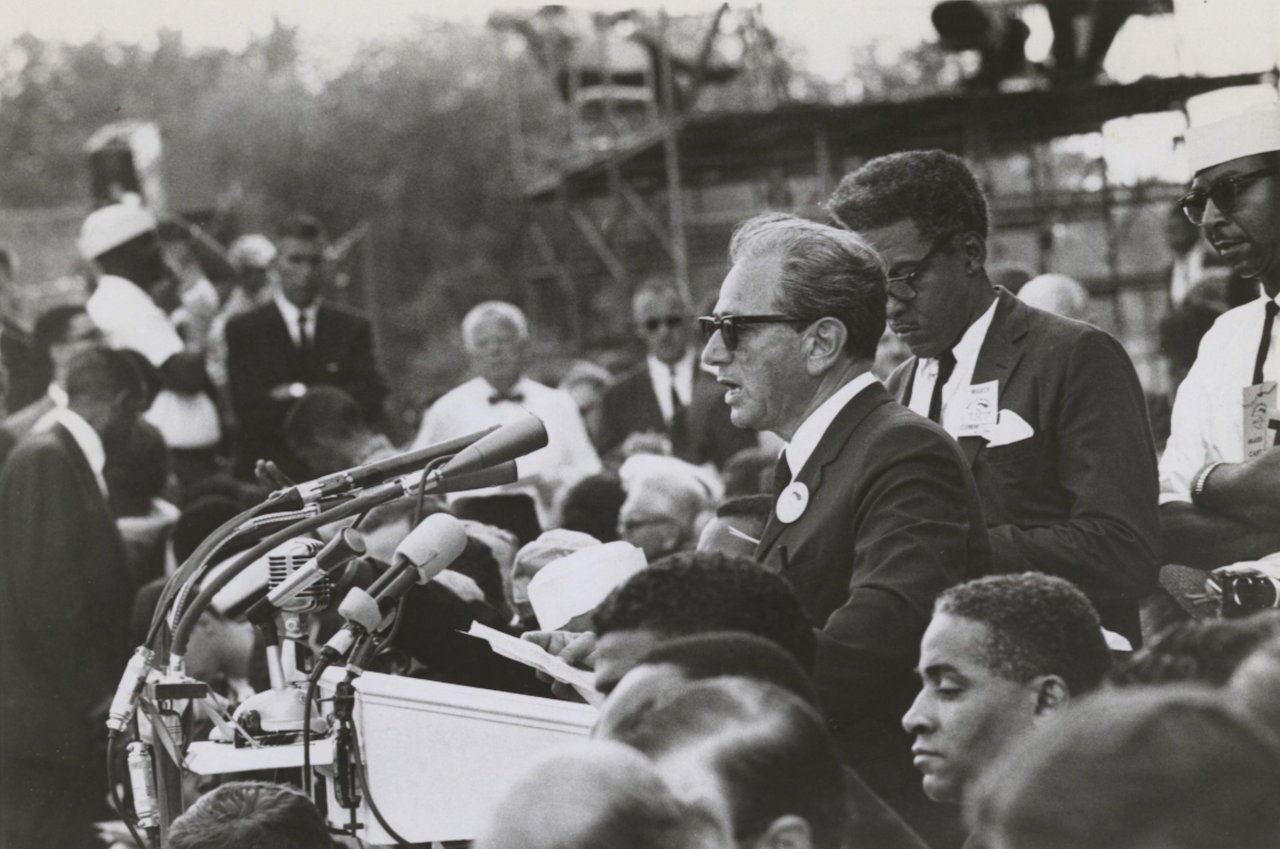
Fig. 3: Joachim Prinz holding his speech during the “March on Washington for Jobs and Freedom,” Washington, D.C., 28 August 1963. Photo reproduced with kind permission of the American Jewish Historical Society, New York. From the collections of the American Jewish Congress (I-77).
Although Prinz appeared to be the ideal representative of the Jewish community during the March on Washington, his role was in fact rather more ambivalent. The preceding years had been shaped by hefty conflicts between two factions within the AJCongress concerning Jewish participation in the civil rights movement. While one faction, headed by the lawyer Justine Wise-Polier (1903–1987) and her husband Shad Polier, argued that the AJCongress should treat the struggle for civil rights as its main goal, to which all Jewish particularist interests should be subordinated, the faction headed by Prinz saw its main task as securing Jewish survival. The civil rights movement could be a means to this end, but should never become an end in itself. Yes to the civil rights movement, but only “as Jews and because we are Jews,” as Prinz put it in 1958.
This conflict presumably also owed to different forms of socialization. For activists born in the United States, like the Polier couple, the situation of the African American community was a key element of their own biography and identity, and thus a fundamentally American issue. By contrast, immigrants from Europe were preoccupied with their personal experiences of antisemitism and radical exclusion, which is why issues concerning their own group identity predominated.
Even if Prinz was eventually able to officially resolve this conflict in his favor when, at the height of tensions in 1958, he was elected president of the AJCongress, the dispute kept bubbling under the surface. Although Prinz softened his own position following his election, he stuck to his basic convictions. This background informs the very first sentence of his speech in Washington, in which he emphasized that participation in the civil rights movement should not be grounded in an unspecific and universalist standpoint, but exclusively in a Jewish standpoint: “I speak to you as an American Jew.” However, Prinz did not continue to emphasize Jewish particularist interests in the remainder of his speech, a fact that could be interpreted as a concession to his critics or even as a modification of his own position.
The March on Washington and Prinz’s speech held on this occasion are viewed to this day as one of the high points of Jewish-African American cooperation. Prinz, who died as an American citizen in New Jersey in 1988, is consequently still revered as a civil rights rabbi. However, this cooperation had already begun to erode before 1963, and in any case, the connection had never been as strong as is often perceived and represented in hindsight. From the 1960s onward, preexisting conflicts and tensions came ever more to the fore – especially those owing to the totally different socioeconomic conditions and developments of the two communities. As a result, the respective particularist interests of this period were articulated ever more clearly, encompassing Black Power on the one hand and solidarity with Israel on the other. With the end of the liberal consensus that had for a long time connected the leading figures of the two communities, the cooperation between them finally also ended. Although the Jewish-African American cooperation of that time may sometimes be excessively idealized and romanticized as a black-Jewish alliance, especially in Jewish memory, it nevertheless encapsulated the belief in and hope for a universal justice transcending particularisms – a hope that could also enrich the present. Prinz universalized, or at least Americanized, his German-Jewish background and experience of persecution. This could be viewed as his personal contribution to Americanizing the German-Jewish diaspora.
Official website: www.joachimprinz.com. The website offers documents, photos, and videos on the life and work of Joachim Prinz and was designed by his son Jonathan Prinz.
Speech by Joachim Prinz at the March on Washington, Washington, D.C., 28 August 1963: www.youtube.com/watch?v=pIJ0Pr7JBY8
Rachel Eskin Fisher/Rachel Nierenberg Pasternak (dir.), Joachim Prinz: I Shall Not Be Silent [Documentary film], Menemsha Films, 2014, accessed 21 April 2026, https://www.youtube.com/watch?v=2wNcdiBUDK0.
Allan Nadler, The Plot for America, in: Tablet. A New Read on Jewish Life (Online). https://www.tabletmag.com/sections/news/articles/the-plot-for-america
Rachel Eskin Fisher/Rachel Nierenberg Pasternak (dir.), Joachim Prinz: I Shall Not Be Silent [Documentary film], Menemsha Films, 2014, accessed 22 April 2026, https://www.youtube.com/watch?v=2wNcdiBUDK0.
This work is licensed under a Creative Commons Attribution - Non commercial - No Derivatives 4.0 International License. As long as the material is unedited and you give appropriate credit according to the Recommended Citation, you may reuse and redistribute it in any medium or format for non-commercial purposes.
David Jünger is a research associate at the Moses Mendelssohn Center for European-Jewish Studies, University of Potsdam. He earned his PhD from the University of Leipzig in 2013 and has since held academic positions at the Free University of Berlin, the University of Sussex, and the University of Rostock. His second book on the German-American rabbi Joachim Prinz (1902–1988) was completed in 2025 and is forthcoming in 2026. His publications include Jahre der Ungewissheit. Emigrationspläne deutscher Juden 1933–1938, Göttingen: Vandenhoeck & Ruprecht, 2016; Kulturen des Verdrängens und Erinnerns. Perspektiven auf die rassistische Gewalt in Rostock-Lichtenhagen 1992 (ed. with Gudrun Heinrich/Oliver Plessow/Cornelia Sylla), Berlin: Neofelis, 2024, as well as “Historische Erfahrung und politisches Handeln. Rabbiner Joachim Prinz, der Nationalsozialismus und die afroamerikanische Bürgerrechtsbewegung“, in: Vierteljahrshefte für Zeitgeschichte vol. 70, no. 1 (January 2022), 1–30.
David Jünger, Divided Experiences: Joachim Prinz, the Jewish Struggle against Racism in the United States, and the “March on Washington for Jobs and Freedom” on 28 August 1963 (translated by Tim Corbett), in: (Hi)stories of the German-Jewish Diaspora, January 21, 2026. <https://diaspora.jewish-history-online.net/article/gjd:article-48> [September 24, 2026].
 This work is licensed under a Creative Commons Attribution - Non commercial - No Derivatives 4.0 International License. As long as the material is unedited and you give appropriate credit according to the Recommended Citation, you may reuse and redistribute it in any medium or format for non-commercial purposes.