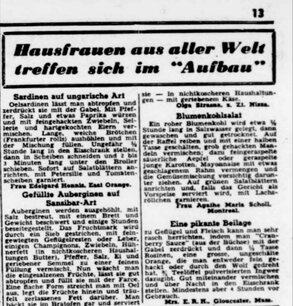
“Housewives from around the world meet each other in the Aufbau,” declared the headline in the paper’s January 25, 1957, edition. It published four recipes by women residing in different places who shared their favorite dishes for the benefit of Aufbau readers, just like themselves. Tucked in page 13 and covering a humble spot on the top right corner of the page, this was clearly not a major media event. The paper’s opening pages delivered the urgent news of the hour, from the aftermath of the Suez Crisis in the Middle East to the state of Soviet suppression in Hungary. Interspersed among those were reports and essays that reflected the interests of the core readership, for example: updates from Jewish communities across Europe, a eulogy for the recently deceased Italian-American conductor, Arturo Toscanini (1867–1957), and news of the latest winner of the Peace Prize of the German Book Trade. While seemingly of lesser consequence, the short feature on page 13 that addressed “housewives from around the world” is equally revealing of the Aufbau’s history, its function, and its meaning as one of the most important publications of the German-Jewish diaspora.
The flight of German-speaking Jews during the years of Nazi terror and their dispersion throughout the world saw the emergence of multiple regional newspapers and press organs that catered to the readership of Central European refugees. The Aufbau, which was published in New York, was for many decades the most widely circulated and influential of these papers. Like the British AJR Information or the Mitteilungsblatt published in Palestine/Israel, the Aufbau was created as the communications organ of a community organization, the German-Jewish Club. When this organization was founded in 1924 in New York, it served as a type of landsmanshaft with a membership of several hundred Jews of Central European, primarily German origin. With the influx of Jews fleeing Central Europe in 1933 and onwards, the German-Jewish Club quickly expanded into a self-help society that catered to the various needs of this growing refugee population, and was renamed the New World Club in 1940.
The very first edition of Aufbau was published on December 1, 1934, and very much bore the character of a community newsletter. It was initially published monthly, printed with a circulation of about 500 copies that were distributed to members of the German-Jewish Club. Within a few years, the emergence of a large German-Jewish population in the United States (numbering between 120,000 and 150,000 people) and the circumstances under which it came into existence transformed this newsletter into an esteemed weekly publication with a wide readership and an impressive circulation. At its peak, during the 1940s, the Aufbau had a circulation of about 45,000 copies every week.
Responding to the growing German-Jewish readership base, Aufbau’s rise was also shaped by the arrival of Manfred George (1893–1965) as chief editor in 1939. George was a prolific journalist in Germany during the First World War and the Weimar Republic era. He fled Germany in 1933, shortly after the establishment of the Nazi dictatorship, first to Prague. In 1938, following the German invasion of Czechoslovakia, George continued his flight across the Atlantic Ocean to New York. Under his editorial hand, the Aufbau developed into a serious and professional publication. The paper’s coverage of local, national, and international politics and culture was expanded significantly. Prominent thinkers of the German-speaking community in displacement frequently published essays and commentaries there. Among them were novelists Thomas Mann (1875–1955) and Lion Feuchtwanger (1884–1958) or philosopher Hannah Arendt (1906–1975), to name only a few.
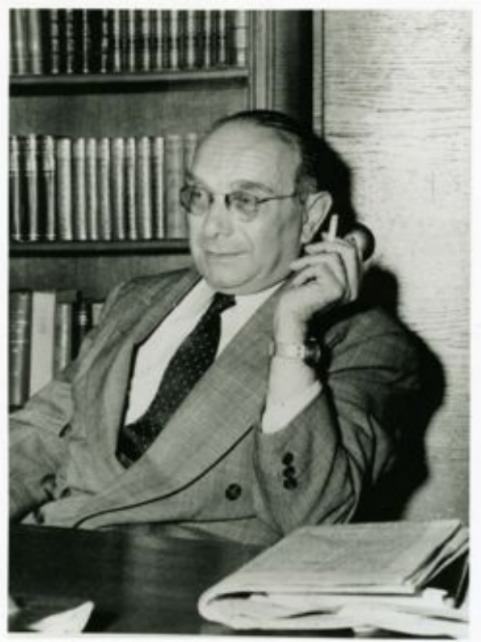
Fig. 1: The journalist and editor-in-chief of Aufbau, Manfred George, undated; Manfred George Collection AR 2233, F 13614, Leo Baeck Institute, New York.
George saw the Aufbau as a tool for preserving German-Jewish cultural heritage while facilitating the integration of German-speaking Jewish refugees into American society. “Know Your America!,” read one section in the January 1, 1943 edition. “Every month we print important historical events, which occurred in the corresponding month throughout the life of our nation.” In that very same edition, alongside this explicit call to learn and to identify with the new homeland, were numerous sections that strengthened the sense of cultural patriotism for German-speaking Jews, from reviews of newly released antifascist poetry books through coverage of the “hopeless” match of the Viennese-Jewish Hakoach football team to the advertisements that emphasized the Central European origin and quality of refugee-owned businesses. This effort to cultivate simultaneous dual belonging was a major characteristic of the Aufbau for decades. Notably, the paper was published in the German language (as opposed to, for example, the British AJR Information, which adopted English as the primary language of publication), though occasional English-language essays and reports were printed as well.
Alongside these functions, Aufbau kept its original objective as a community-oriented paper, and with its much broader reach, it was able to function as an advocacy organ that represented the interests of the German-Jewish community on both national and international stages. Aufbau regularly addressed injustices embedded in the American immigration system and how they prevented the rescue of more Jews trapped in Europe. When the war was still waging, Aufbau published reports about the extent of Nazi genocidal violence, providing an early account of the horrors that would come into full view only years afterwards. Later, as the world was coming to terms with the extent of these crimes, Aufbau was a central voice in tracking and criticizing lackluster judicial efforts against Nazis and their collaborators. The paper also played a significant role in lobbying for postwar reparations for individual victims, and in instructing readers on how to pursue their claims. This multifaceted content strategy was not the only way in which the paper supported its readers’ community. With its impressive growth, Aufbau even became a revenue-generating organ for the New World Club and was able to contribute funding to the organization’s activities and initiatives.

Fig. 2: Delivery truck body for the Aufbau, early 1950s; Lilo Goldenberg Family Collection AR 25799, Box 3 Folder 15, Leo Baeck Institute, New York.
Back to the “Housewives” section that opened this essay, two of the recipes published on this particular date (Aufbau published this feature on a somewhat regular basis during the 1950s) arrived from the East Coast of the United States: one from East Orange in New Jersey and the second from Gloucester in Massachusetts. A third arrived from Montreal, Canada, while the fourth was sent from a reader who listed her residence as “currently in Nice,” Southern France. This small section thus offers an example of Aufbau’s remarkable diasporic function. Bringing readers into the homes and kitchens of these four recipe authors, the paper’s clientele could marvel at the global extent of their community in dispersal through the intimate act of sharing ideas for meals.
Based in New York, Aufbau was not only able to reach German-Jewish readers far beyond the city, it even provided a platform for these readers to hold conversations and exchanges among themselves. Other sections published in the paper demonstrated this as well. Alongside frequent articles authored by German-speaking Jews residing across the globe, Aufbau regularly printed Letters-to-the-Editor from readers around the world, as well as obituary notices, advertisements, and announcements that testified to its global readership.
In a 1959 interview with Time Magazine, editor Manfred George described Aufbau as “a paper for uprooted people all over the world” Unnamed author, “The Press: The Refugee’s Best Friend,” in: Time Magazine, November 23, 1959. and boasted that it was distributed to as many as eighty-three countries worldwide. During its peak distribution years in the 1940s and 1950s, Aufbau could be purchased in certain newsstands and bookshops in places that had a particularly large concentration of German-speaking Jews, such as London or Palestine/Israel. As late as 1972, then editor Norbert Goldenberg (1909–1974) noted that the Aufbau was still read in fifty-eight different countries, circulating in communities of German-speaking Jews across their diaspora but also in the German-speaking countries from which they were displaced in the 1930s and 1940s. In West Germany, it was read not only by the Jewish population then living in the country but also by politicians and intellectuals invested in keeping track of German-Jewish commentary.
Though it was primarily geared towards German-Jewish readers in the United States, and though it had a strong local emphasis on New York City and its surroundings, Aufbau consciously addressed the global dispersion of German-speaking Jews both in its content and in its marketing. While readers from around the world could and did contact the New York office directly, in some countries, Aufbau even had representatives who sold subscriptions as well as advertising space locally.
The “Housewives” section reveals another important facet of Aufbau as a publication: the paper is a treasure trove of information about the day-to-day experiences of German-speaking Jews in the diaspora. In manifold ways, Aufbau’s content documented how readers navigated life as newcomers after flight. From the featured lectures, films, and musical performances, one can get a sense of German-Jewish cultural worlds. From the countless advertisements printed there, it is possible to trace the economic landscape that the refugees settled into, and also to observe their efforts at balancing old and new habits and tastes. Noting addresses and locations of various gathering sites conveys the social geography of the German-speaking community in New York.
Reading the Aufbau in search of German-Jewish everyday life also demonstrates the centrality of gender to the formation of diasporic culture. As documented by historians like Marion Kaplan and Viola Alianov-Rautenberg Viola Alianov-Rautenberg, No Longer Ladies and Gentlemen: Gender and the German-Jewish Migration to Mandatory Palestine, Stanford: Stanford University Press, 2023; Marion Kaplan, Between Dignity and Despair: Jewish Life in Nazi Germany, Oxford: Oxford University Press, 1998, especially 62–71; “‘Did you bring any girls?’ Gender Imbalance in a Jewish Refugee Settlement: Sosuá, the Dominican Republic, 1940–1945,” in: Gender and Jewish History, ed. Marion A. Kaplan/Deborah Dash Moore, Bloomington: Indiana University Press, 2011, 104–19., the forced migration of Central European Jews led to significant changes in both perceptions and experiences of gender dynamics (though without altering these dynamics altogether). In the example of the “Housewives” section, we see how, on one hand, women were identified as promulgators of German-Jewish diasporic bonds. Yet their participation in this instance was constrained to the realm of the kitchen. This attitude was common in the Aufbau’s content relating to women. The paper often praised their contributions to the support of the refugee community and to the integration efforts into American society, while making clear that their contributions were welcomed primarily in the domains that were conventionally coded as female: in the household, in raising children, and in social or educational work.
Aufbau celebrated gendered “success stories” as exemplars of the bittersweet triumphs of the entire German-Jewish community in migration. The regular column “Woman’s World” published on March 28, 1947, features a profile of Hansi Share’s (1887–1981) doll manufacturing business under the title: “A woman-immigrant makes a career.” The piece highlights Share’s transformation, brought about by the experience of forced migration. A wealthy widow back in Germany who had become a needy refugee in the United States, she stated in the interview: “Back there I was a leech. Here I became a worker,” describing the arduous labor necessary to keep her business running. The designs for her Monica Dolls, she explained, came from her memories of the classy fashion houses she frequented in “the old world.” Nostalgia, loss, and determination, here conveyed through Share’s personal fate, were common tropes in how the Aufbau crafted a German-Jewish version of the American Dream mythos.
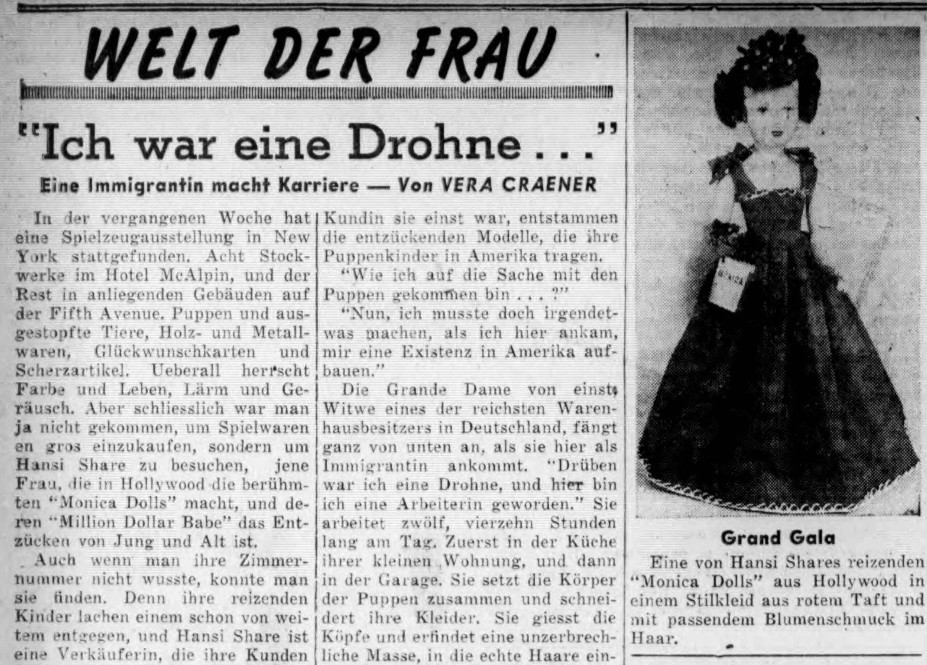
Fig. 3: Interview with Hansi Share, creator of the Monica Doll. Aufbau, March 28, 1947.
While Aufbau remained an influential publication in the first postwar decades, the paper’s impact had diminished significantly towards the end of the twentieth century, as the German-Jewish readership declined in numbers. The paper discontinued its operations in 2004, and its copyright was purchased by new owners based in Switzerland who continue to publish it as a monthly magazine with an online platform.
As historian Peter Schrag noted, Aufbau’s mission of guiding German-Jewish integration into American society and into the post-Nazi era “carried within it the seeds of its own demise,” Peter Schrag, The World of Aufbau: Hitler’s Refugees in America, Madison, WI: University of Wisconsin Press, 2019, 27. as fewer and fewer people relied on it to interpret and represent their world and interests. With all of its print editions available digitally, Aufbau remains one of the most valuable sources on the history of the German-Jewish diaspora. It provides a unique window into the lives of German-speaking Jews in the United States and beyond, chronicling decades of their efforts to reconstruct and redefine the German-Jewish world in light of the disruptions that it endured.
Website of the online journal Aufbau. Das jüdische Monatsmagazin: https://www.aufbau.eu/
Digitized issues of the Aufbau (1934–2004), Leo Baeck Institute: https://www.lbi.org/collections/periodicals/aufbau/
“The World of Aufbau”, panel discussion with Peter Schrag and Shira Kohn at the Center for Jewish History, September 10, 2019: https://www.lbi.org/events/world-aufbau/
Andreas Mink, “’Aufbau’ – Reconstruction as a Mission”, 2013: https://www.lbi.org/news/aufbau-reconstruction-as-a-mission/
This work is licensed under a Creative Commons Attribution - Non commercial - No Derivatives 4.0 International License. As long as the material is unedited and you give appropriate credit according to the Recommended Citation, you may reuse and redistribute it in any medium or format for non-commercial purposes.
Dr. Sheer Ganor is a historian of German-speaking Jewry and modern Germany. Her work focuses on the nexus of forced migration, memory, and cultural identities. She is currently working on a book that traces the emergence of a transnational diasporic network of Jewish refugees who escaped Nazi Germany and its annexed territories. Prior to joining the University of Minnesota, she held a postdoctoral research fellowship at the German Historical Institute. She has published in Central European History, the Journal of Contemporary History, the Journal of German History, and other venues. Her research has been supported by a variety of academic institutions, including the Leo Baeck Institute, the Central European History Society, and the Studienstiftung des deutschen Volkes.
Sheer Ganor, Aufbau: From New York to the Diaspora, in: (Hi)stories of the German-Jewish Diaspora, April 08, 2026. <https://diaspora.jewish-history-online.net/article/gjd:article-57> [October 08, 2026].
 This work is licensed under a Creative Commons Attribution - Non commercial - No Derivatives 4.0 International License. As long as the material is unedited and you give appropriate credit according to the Recommended Citation, you may reuse and redistribute it in any medium or format for non-commercial purposes.