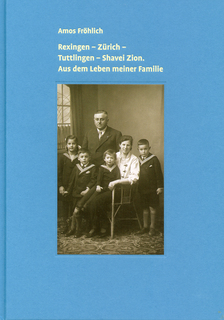
Amos Fröhlich was born into a Jewish family in Tuttlingen, Swabia, in 1930. Along with his parents and siblings, he managed to escape to Mandatory Palestine shortly before the November Pogroms of 1938. In his autobiography, Fröhlich describes his life and family history, the establishment of the agricultural settlement Shavei Zion in Israel, and the growing exchange between Germany and Israel. The memoir was published in German in 2020. It is based on recollections, correspondence with other contemporary witnesses, and personal documents and photographs.
Fröhlich initially wrote his autobiography in Hebrew for his family and friends in 2012. He then translated it orally into German. Like many members of the German-Jewish diaspora who fled as children, he is fluent in German, which shaped the family’s everyday life for many years after their flight. The German translation was then transcribed by the bookseller Barbara Staudacher and the publisher Heinz Högerle, who have been involved for many years in the Träger- und Förderverein Ehemalige Synagoge Rexingen (Association for the Support and Promotion of the Former Synagogue in Rexingen) and in German-Israeli exchange. This background underscores the source’s character as a testament to growing German-Israeli relations.
The cover of the autobiography shows a photo of the Fröhlich family before their forced migration, echoing the Israeli national colors through its blue-white color scheme. The book includes several short autobiographical texts by other family members as well as 171 illustrations, mostly photographs from Fröhlich’s family collection and the archives of Shavei Zion. It is therefore an intergenerational document. Fröhlich himself is representative of the German Jews who escaped with their families as young children and spent most of their youth outside Germany. Their experiences often differed greatly from those of the adult members of the German-Jewish diaspora, which could lead to intergenerational tensions. While the adults of Shavei Zion’s founding generation left behind many primary sources about the development of the community, Fröhlich’s autobiography offers insights into the lives and memories of the youngest members of the German-Jewish diaspora.
Amos Fröhlich was born Walter Fröhlich in Tuttlingen, in southern Baden-Württemberg, in 1930 as the third of four children. The family of his father, Julius Fröhlich (1896–1963), originally came from the village of Rexingen, about eighty kilometers to the north. The family had lived in Rexingen since the early eighteenth century and remained members of Rexingen’s Jewish community even after moving to Tuttlingen. Though Rexingen was predominantly Catholic at the time, it was also home to one of the largest rural Jewish communities in Württemberg. Around 1850, Jews made up 36 percent of the population of the formerly independent municipality of Rexingen – which today forms part of Horb am Neckar – and were classified as so-called Landjuden (rural Jews). This was a diverse group of people involved, among other things, in the livestock trade, as was the Fröhlich family.
After the appointment of Adolf Hitler (1889–1945) as Reich Chancellor, the Fröhlichs attempted to shield their children from growing antisemitism in everyday life. The political upheaval was particularly painful for Julius Fröhlich, who had worked for many years as a respected cattle dealer in the region, served in the German army during the First World War, and considered himself a German patriot. In the mid-1930s, the family finally decided to leave Nazi Germany. Fröhlich’s mother, Elise Fröhlich, née Leibischau (1905–2000), had been born in Zurich. However, emigration to Switzerland was not possible as she had lost her Swiss citizenship when marrying a German, and Julius Fröhlich was not granted a work permit there. Many German Jews seeking to leave Nazi Germany faced similar problems as the Fröhlich family. In September 1938, a few weeks before the November Pogroms, the Fröhlich family was finally able to leave Tuttlingen for Mandatory Palestine. There, they became co-founders of the village Shavei Zion.
The title of Fröhlich’s autobiography names Shavei Zion along with the birthplaces and residences of his parents and ancestors, thus following a so-called life path metaphor. This is typical of many memoirs by German Jews in Israel and underscores their multiple affiliations. In Fröhlich’s case, the genealogical references additionally reflect the intergenerational content of the autobiography.
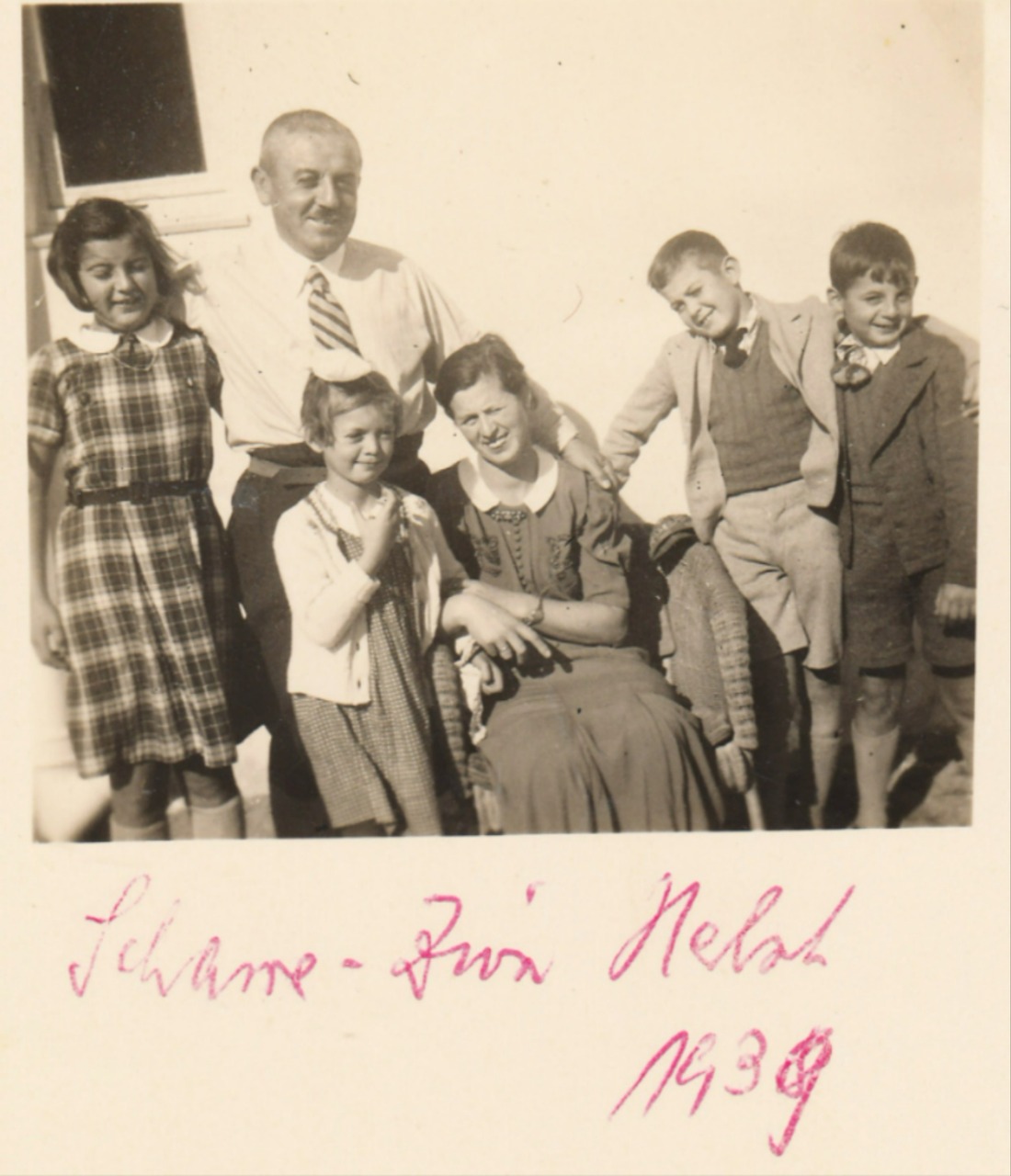
Fig. 1: The Fröhlich family in the fall of 1939, shortly after their arrival in Shavei Zion. From left to right: the sister Sonja (1926–1948), the father Julius (1896–1963), the sister Eleanora (Esther) (1932–2019), the mother Elise (1905–2000), the brother Helmut (Elkana) (1927–1992), and Walter (Amos) Fröhlich; Amos Fröhlich’s private archive, Shavei Zion, Israel.
Amos Fröhlich wrote his autobiography in Shavei Zion, where he spent most of his life. Almost half of the text is devoted to his family’s life in Germany before their flight as well as to the early years of Shavei Zion, thus underscoring the importance he attached to these periods.
The village Shavei Zion in northern Israel was founded in 1938 by Swabian Jews who predominantly came from Rexingen and Tuttlingen. Among them were the Fröhlichs, who had decided to migrate to Eretz Israel together with this larger group, hoping this would improve their chances of receiving the necessary permits. At the time, anyone wishing to immigrate to Mandatory Palestine – whether Jewish or not – required a certificate, the issuance of which was increasingly restricted by the United Kingdom.
Shavei Zion was a new form of settlement, called a moshav shitufi, which combined individual household management with cooperative agriculture. The preservation of private property and personal space was decisive for the Fröhlich family in choosing this form of settlement. Like many other Jews from Germany, who are known as Yekkes in Israel to this day, Fröhlich’s parents preferred such a ‘middle-class settlement’ to a collective kibbutz.
Shavei Zion was built in just one day as a so-called wall-and-tower settlement north of the city of Acre on land purchased by the Jewish National Fund (JNF) in 1934. In the wake of the so-called Arab Revolt, there were numerous attacks from 1936 onward by the local non-Jewish population, who opposed Jewish immigration. Shavei Zion was subsequently equipped with a watchtower, demonstrating that the European refugees were not reaching a safe country.
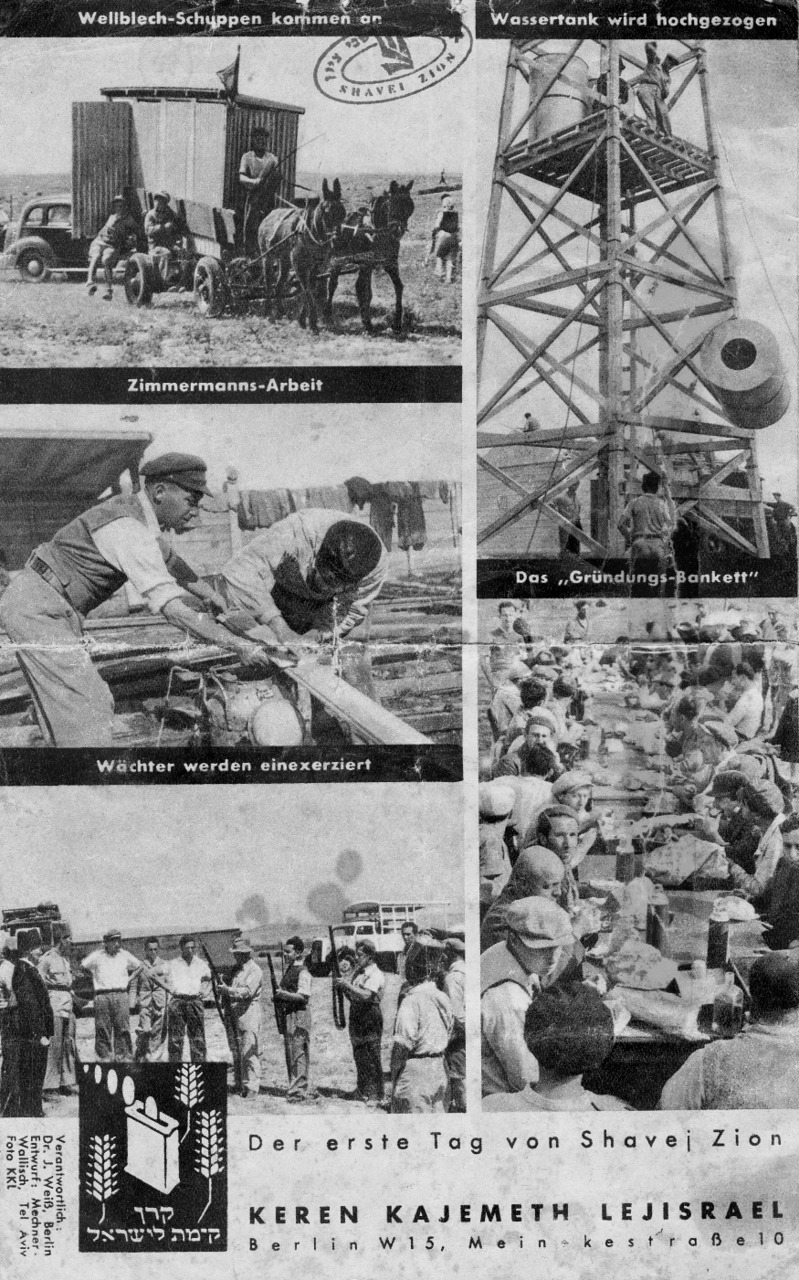
Fig. 2: “The First Day of Shavei Zion.” JNF promotional leaflet depicting the construction of Shavei Zion. Among the images are men from the settlement being ‘drilled’ as guards, April 1938; Shavei Zion archives.
In his autobiography, Amos Fröhlich describes the climate, culture, language, inhabitants, and landscape in Palestine as initially “totally foreign.” Amos Fröhlich, Rexingen-Zürich-Tuttlingen-Shavei Zion. Aus dem Leben meiner Familie, Rexingen 2020, 30. Upon his arrival, the then eight-year-old decided to adapt to these new living conditions as quickly as possible. Fröhlich’s attitude was typical of many Yekkes children. Most of the adults in the group suffered as a result of their flight and struggled for a long time to settle in a country so different from Germany. This was generally regarded with incomprehension by the younger generation. According to Fröhlich, his generation was proud to live “in the land of our fathers.” Ibid., 62. He and his three siblings, unlike their parents, therefore adopted Hebrew first names. However, Fröhlich’s older sister Sonja (1926–1948) later reverted to her German first name. The Fröhlich family, who retained their German surname, therefore reflect the diversity of the German-Jewish diaspora.
Shavei Zion was unique in the 1930s due to the group immigration of its founders, who built their settlement on the basis of intensive agriculture. Their experience in the livestock trade prepared them better for life there than many other Yekkes, who had previously worked in academic or commercial professions in Germany. Fröhlich also underwent agricultural training and was appointed manager of Shavei Zion in 1953 at only 23 years of age. On behalf of the Jewish Agency (JA), he worked as an instructor in other agricultural settlements, where he later provided agricultural guidance to new immigrants – including Jewish refugees from North Africa.
In the foreword to his autobiography, Amos Fröhlich mentions his desire to leave a legacy for future generations. Autobiographies have a long tradition among German Jews, spreading globally through (forced) migration movements, particularly in the Nazi era. Most of them are now kept within families or in archives. They are therefore not available or only partially accessible to the public. Fröhlich’s decision to publish his autobiography in German enables an interested public to access this primary source.
This choice can be attributed to Fröhlich’s long-standing commitment to German-Israeli exchange. He himself returned to Germany in 1957 to complete a so-called ‘Begabten Abitur’ (a high school diploma for particularly gifted students) and to study at university there. This decision was anything but easy for him: “One was still ashamed to admit that one wanted to go to Germany,” Fröhlich recalls. “Everything was still too close to the terrible events that had occurred there a few years earlier.” Ibid., 125.
In general, the mood toward Germany, German culture, and the German language in Israel after the Shoah was very negative, which particularly aggrieved many older Yekkes. Of the 126 Jews from Rexingen who had not managed to escape in time, only three survived the Shoah. Fröhlich’s aunt Martha Fröhlich, née Münz (1895–1941), his uncle Simon Fröhlich (1898–1941), and his grandmother Auguste Fröhlich, née Schwarz (1869–1942), had also been murdered in the Shoah.
Fröhlich’s own temporary return to his country of birth took place in 1957 – eight years before the official establishment of German-Israeli relations in 1965. When Fröhlich moved to Germany, he first had to abandon his Swabian-accented “Küchendeutsch” Ibid., 126. (kitchen German) – as he calls it in his autobiography – and learn High German.
After receiving his high school diploma, he studied veterinary medicine in Munich. During his studies, he kept his distance from older Germans, whose behavior during the Nazi era he could not assess or who even viewed the years between 1933 and 1945 favorably. However, he formed close friendships with younger Germans and those who distanced themselves from the Nazi regime. He also met his future wife, Gila, during this time. In 1965, he returned to Shavei Zion with Gila (Gisela) Fröhlich, née Drews (born in 1939), and their daughter. Back in Israel, Fröhlich worked, among other things, as the private veterinarian for the moshav’s cowshed until his retirement in 2001.
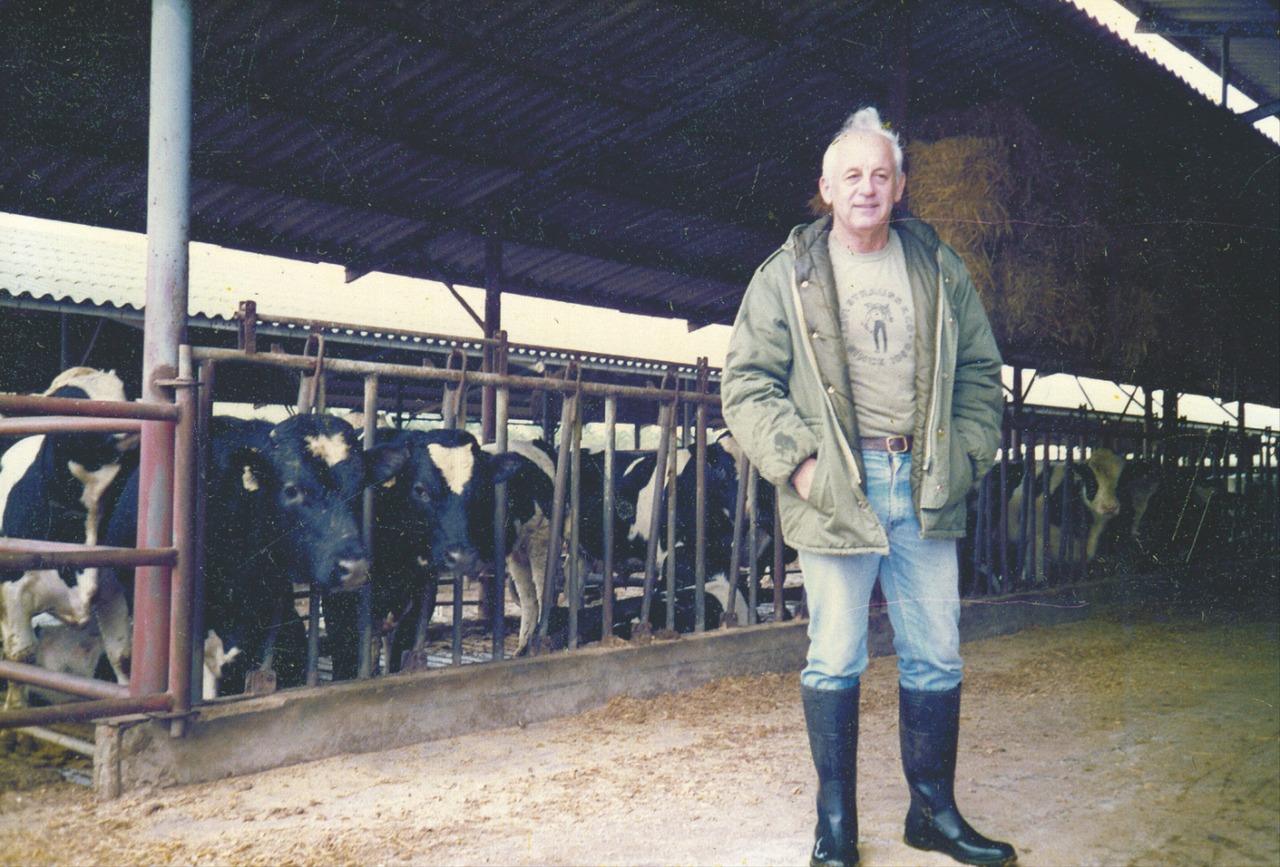
Fig. 3: Amos Fröhlich in the cowshed of Shavei Zion before his retirement in 2001, Amos Fröhlich’s private archive, Shavei Zion, Israel.
Although Fröhlich experienced Holocaust trivialization and antisemitism in Germany, he already advocated for German-Israeli exchange during his university studies. He remains active in this field today and works closely with the Träger- und Förderverein Ehemalige Synagoge Rexingen. This association was founded in 1997 with the goal of preserving Rexingen’s Jewish history and promoting German-Israeli understanding. In terms of the association’s research and educational work, Fröhlich is the last contemporary witness of the so-called Rexingen Jews in Israel. In 2015, he was awarded the Federal Cross of Merit for his services in German-Israeli reconciliation. He led German visitor groups through Shavei Zion until he was of an advanced age, thus making him one of the Yekkes who became bridge builders between Germany and Israel.
Autobiographies are strongly influenced by the circumstances of the times in which they are written. With his memoir, Fröhlich wrote against growing antisemitism, a central element in German-Jewish autobiographies for centuries. Like other Yekkes, he demonstrated his family’s deep roots in Germany, their achievements, and the sacrifices they made for the country – for example, as soldiers in the First World War. In doing so, Fröhlich exposed antisemitic stereotypes and prejudices. By examining the fate of his family members murdered in the Shoah, he simultaneously exposed the lies of Holocaust deniers.
For the Yekkes, the equation of Germany with National Socialism and the ideal of Israel as a so-called melting pot, which was supposed to transform the immigrants’ cultures of origin into a new Zionist identity, had long been a heavy burden. Only in recent decades have the contributions of German Jews in building the new state been recognized in Israel. In his autobiography, Fröhlich emphasizes the difficult living and working conditions there, especially in the early years of Shavei Zion. He attributes the strong commitment of his parents’ generation to the group’s Central European origins. Fröhlich thereby contradicted critics in Israel who condemned the adherence of many Yekkes to the German language and culture. For him, the cultural roots of the founding generation were the key to the success of Shavei Zion, which became a model for many other Jewish settlements.
The deep connection to their homeland, Israel, and the great pride in their own role in building the country, as expressed in Fröhlich’s autobiography, were widespread among the German-Jewish children and young people who fled to Palestine in the 1930s. Typical for them was also a lack of understanding shown for their parents’ and grandparents’ difficulties in adjusting. In Shavei Zion, as in most German-Jewish ‘middle-class settlements,’ German was initially used for (almost) all communication. Only after 1957 were community meetings held exclusively in Modern Hebrew (Ivrit). Children and young people more easily adjusted to the new language than adults. This sometimes led to tensions within families, as the younger children spoke Ivrit among themselves, while the older generations could not fully follow the conversations. In his autobiography, Fröhlich reflects on how flight and the move to a foreign environment was more traumatic for his parents and grandparents than for his own generation. This analysis took place after the death of his parents and therefore provides insights into the different challenges faced by the parent and child generation in Palestine/Israel.
Amos Fröhlich’s autobiography concludes with a description of the inauguration of “Julius Fröhlich Platz” in Tuttlingen on 2 October 2015. The square was renamed in memory of Fröhlich’s father 77 years after the family’s flight. Amos Fröhlich, who was awarded the Federal Cross of Merit on the same day, sees himself as one of the last representatives of all those expelled from Germany because of their Jewish heritage. At the end of his autobiography, he highlights the Germans who were involved in the exchange and/or nominated him for the award. Fröhlich regards his personal commitment as a contribution to the fight for “a better future, […] good relationships and contacts.” Ibid., 208.
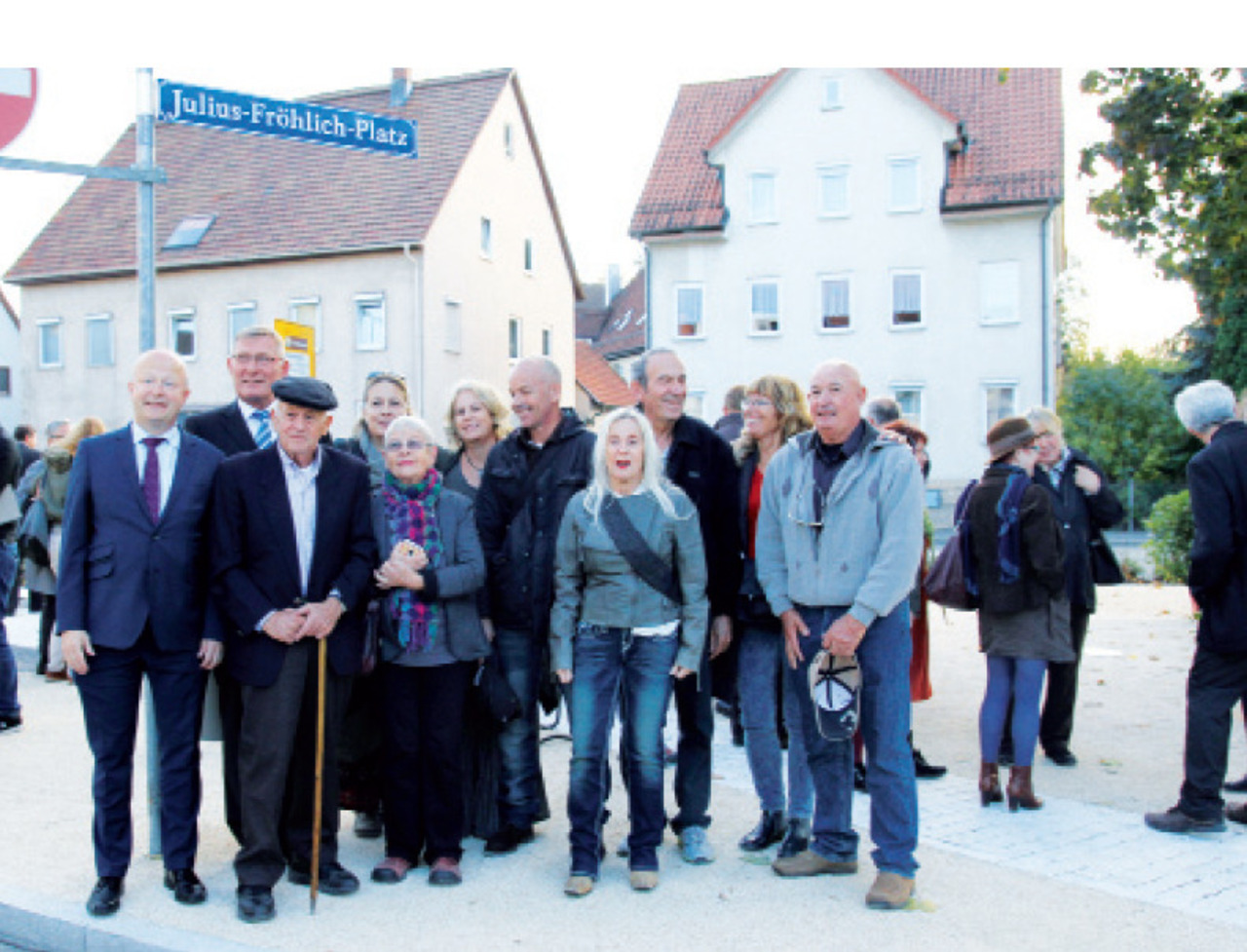
Fig. 4: Amos Fröhlich (third from the left) with his family and representatives of the municipality of Tuttlingen at the renaming ceremony of ‘Julius-Fröhlich-Platz,’ 2015; Barbara Staudacher Verlag.
In his autobiography, Fröhlich, who sees himself as a bridge builder, pays tribute to the “new Germany that strives to assume responsibility and to come to terms with the past.” Ibid. The final chapter, in particular, with its conciliatory tone, reveals how the Jewish side perceives Germany’s reappraisal of Nazi crimes and how Germany’s memory culture evolved – a valuable perspective for the future culture of remembrance.
The autobiography of Amos Fröhlich, who still lives in Shavei Zion and maintains close ties to Germany, offers personal insights into the lives of the youngest members of the German-Jewish diaspora in Israel. While the adults of the founding generation left behind numerous primary and secondary sources about the development of their community in Shavei Zion, this autobiography offers a glimpse into the lives and experiences of German Jews who fled as children and adolescents.
At the same time, Fröhlich’s autobiography exemplifies a vibrant German-Jewish culture of remembrance and German-Israeli rapprochement, which has been put to the test again since the so-called Gaza War in 2023.
The author thanks Amos Fröhlich, Judith Temime, Barbara Staudacher, and Heinz Högerle for their support and for providing the photos.
Amos Fröhlich, Amos Fröhlich: Rexingen-Zürich-Tuttlingen-Shavei Zion. Aus dem Leben meiner Familie, Rexingen: Träger- und Förderverein Ehemalige Synagoge Rexingen & Barbara Staudacher-Verlag, 2020.
Judith Temime, “Hebrew and German: From the Shavei Tzion Archives”, Ehemalige Synagoge Rexingen 2015: https://www.ehemalige-synagoge-rexingen.de/media/pages/orte/shavei-zion/unterseiten/hebraeisch-deutsch/57315b08f5-1768898783/hebrew_and_german_2015_optimiert.pdf
“Wie Amos Fröhlich zum jüdischen Siedler wurde“, Faszination Israel, 15.01.2025: https://faszinationisrael.de/index.php/component/content/article/165-der-jude-der-seinem-hasser-das-leben-gerettet-hat-2?catid=12:zeitzeugenberichte&Itemid=101
“Schawei Zion, ein schwäbisches Dorf am Mittelmeer“, Südwestrundfunk, 26.02.1965: https://www.ardmediathek.de/video/swr-retro-abendschau/schawei-zion-ein-schwaebisches-dorf-am-mittelmeer/swr/Y3JpZDovL3N3ci5kZS9hZXgvbzExNjU4OTU
This work is licensed under a Creative Commons Attribution - Non commercial - No Derivatives 4.0 International License. As long as the material is unedited and you give appropriate credit according to the Recommended Citation, you may reuse and redistribute it in any medium or format for non-commercial purposes.
Leonie S.E. Schottler holds a Master’s in Global Media and Digital Cultures at the University of London (School of Oriental and African Studies). Currently, she is pursuing a Master’s in History at the University of Cambridge. For her Master’s thesis, she is researching the stories, identity, and relationship with post-war Germany of the second and third generation Yekkes. She holds a BA hons in History at the University of London (Royal Holloway). Her Bachelor’s thesis titled “A ‘New Jecke‘? Intergenerational narratives of German-Jewish immigration experiences to Palestine during the 1930s” was based on oral history accounts of first- and second-generation members of the German-Jewish diaspora in Israel and the Netherlands. Schottler is also a keen photographer of history and heritage-related subjects and themes. Her photographic work on “Uncomfortable/Awkward Monuments” has received awards from the Council of Europe in Strasbourg and the German Foundation for Monument Protection (Deutsche Stiftung Denkmalschutz). Her work on the lawyer and Nazi-opponent Dr. Hans Litten, who was of Jewish heritage and murdered in the Concentration Camp Dachau in 1938, has received the First Award of the Hans-Litten-Student-Competition of the German Bar Association (Deutscher Anwaltsverein).
Leonie S.E. Schottler, Amos Fröhlich’s Autobiography: A Bridge Builder between Germany and Israel and the Last Contemporary Witness of the So-Called Rexingen Jews, in: (Hi)stories of the German-Jewish Diaspora, October 20, 2025. <https://diaspora.jewish-history-online.net/article/gjd:article-42> [October 04, 2026].
 This work is licensed under a Creative Commons Attribution - Non commercial - No Derivatives 4.0 International License. As long as the material is unedited and you give appropriate credit according to the Recommended Citation, you may reuse and redistribute it in any medium or format for non-commercial purposes.