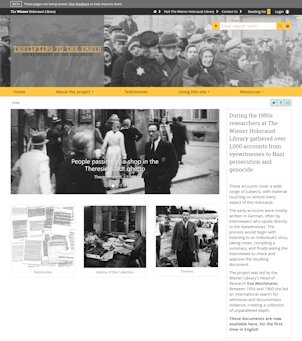
In the mid-1950s, the Wiener Library (now The Wiener Holocaust Library, WHL) in London began an ambitious project to collect written eyewitness accounts from survivors of Nazi persecution and the Shoah. The initiative was led by the German-Jewish refugee scholar, Dr. Eva Reichmann (1897–1998), the Library’s first Director of Research. Supported by the Conference on Jewish Material Claims against Germany (Claims Conference), the project began in London, from where Reichmann directed a small team of paid staff members and additional volunteers. Interviewers were located throughout Europe and were employed to trace, contact, and persuade potential interviewees to take part.
The project continued until the mid-1960s, proceeding in a concentric and centrifugal direction: they began close to London using their network of professional and cultural contacts within German-Jewish circles, and gradually spun out further and further as the network of interviewers and interviewees widened and diversified. The resulting collection consists of some 1,300 reports (including letters, poems, songs, and other written materials predominantly recorded in or translated from German), many of which have formed the basis of a digital resource created by WHL: Testifying to the Truth (testifyingtothetruth.co.uk). The digital resource includes the history and original classification system of the collection, and provides possibilities for searching the collection in new ways. The project illustrates the reach and impact of transnational networks of German Jews rekindled after the Shoah, and the methodology employed by the project organizers exemplifies the efforts of German-Jewish refugees in shaping Holocaust memory. Therefore, the Library as an institution, still in operation today, stands as a testament to the documentation efforts of the German-Jewish diaspora in England and beyond.
The Wiener Holocaust Library is one of the oldest collecting institutions gathering material about the Shoah. The predecessor to the Library, the Jewish Central Information Office (JCIO), collected and disseminated information about the Nazi rise to power as the events unfolded. Rooted in interwar Germany, the WHL was based on the work of the German-Jewish intellectual, Dr. Alfred Wiener (1885–1964) and his Central Association of German Citizens of Jewish Faith (Centralverein deutscher Staatsbürger jüdischen Glaubens, CV) colleagues. It operated on the concept and practice of collecting as a form of activism and information dissemination as political subversion. Due to the dangers inherent in these efforts, Wiener eventually moved his efforts first to the Netherlands in 1933, and then, in 1939, on the eve of war, to London.
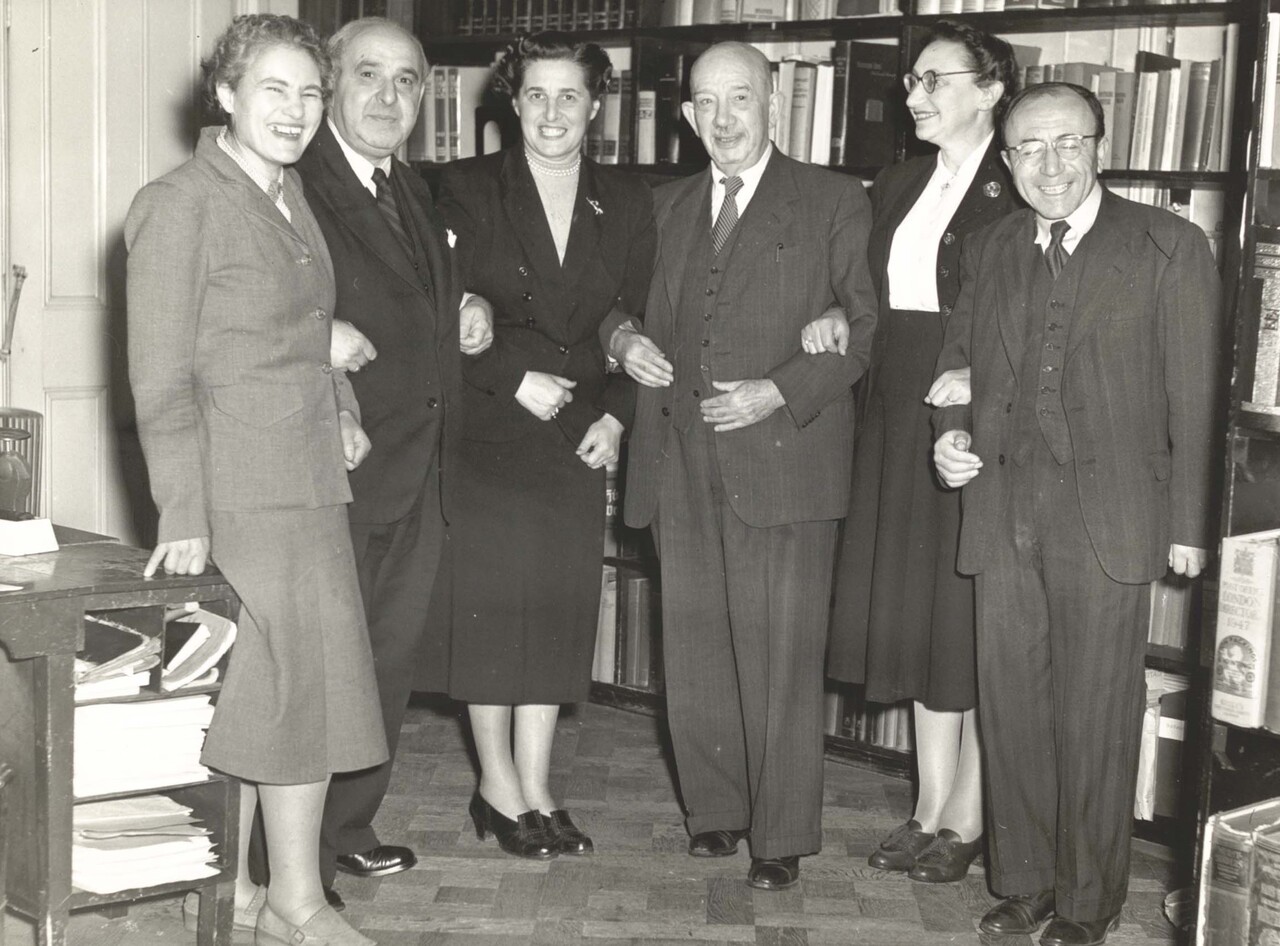
Fig. 1: (left to right) Susanne Rosenstock, Hans Reichmann, Ilse Wolff, Alfred Wiener, Eva Reichmann and Werner Rosenstock - Friends and Staff of the Wiener Library, undated (1950s); Wiener Holocaust Library Collections.
The Wiener Library, as the collection came to be known, continued serving different functions during the Second World War as a source of intelligence on the Nazis for the British government. After the war, it supplied evidence for war crimes trials and produced and fostered research within the fledgling field of contemporary history. This frames and helps contextualize the Library’s efforts to gather eyewitness accounts in the mid-1950s. A fellow former CV member, Dr. Eva Reichmann, sought to fill gaps in the collection through gathering victims’ perspectives. Like Wiener, she was a German-Jewish intellectual and refugee who responded to the rise of the Nazis and the ensuing persecution and destruction through archives-building and research not only as German-Jewish intellectuals in exile, but as persecutees whose families were deeply and tragically affected by these events. The resulting collection of eyewitness accounts, therefore, is significant as a site of knowledge transfer in a diasporic German-Jewish institution in post-war Britain that promulgated transnational links.
The WHL’s project was among the earliest documentation projects supported by the Claims Conference, which was founded in 1951 to administer and negotiate compensation and restitution for Jewish victims of Nazi persecution and, therefore, played a key role in providing material support to Jewish survivors and institutions in the diaspora. Claims Conference funding for the project was facilitated through a partnership with the Holocaust remembrance center Yad Vashem in Israel, which received copies of the reports in exchange for funding dispensed to support interviewing, transcribing, indexing, copying, and archiving. The interviewers were mainly German-speaking Jewish refugees or survivors, located throughout Europe, the United States, and elsewhere, and many were women. The eyewitnesses sometimes authored the accounts themselves, but no surviving guiding questions or standardized approach established uniformity across the collection. Each interviewer brought their own social, cultural, and other contextual framings to the accounts, which were generally co-developed with the interviewees.
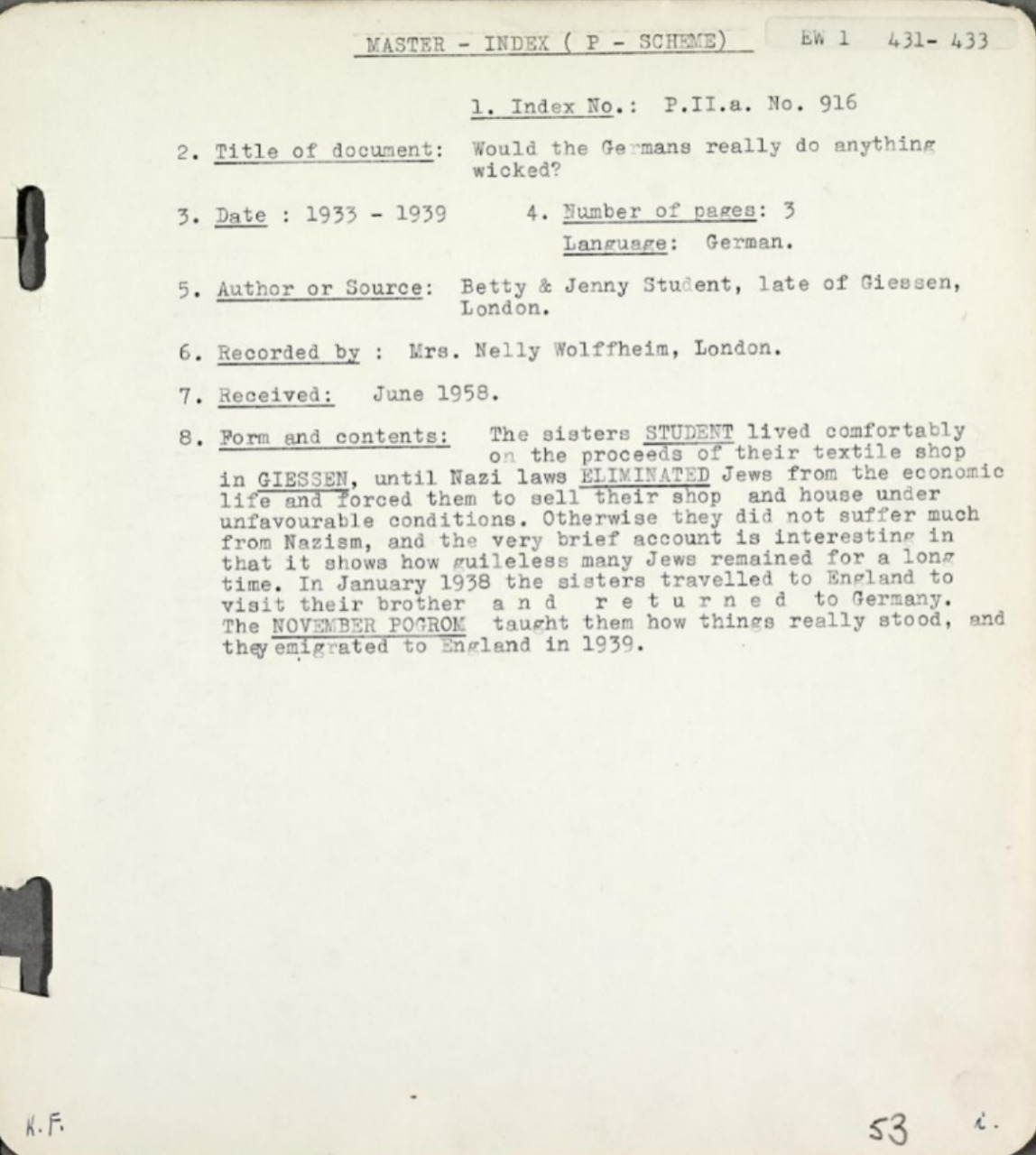
Fig. 2: The cover sheet that indicates the index number, series, cross-indexed terms, title, interviewer, and date of the interview; Wiener Holocaust Library Collections: https://www.testifyingtothetruth.co.uk/viewer/image/104778/1/
The compiled reports were sent to Reichmann and her team of cataloguers, subjected to ‘fact’ verification through a handwritten correction process (also archived in WHL institutional correspondence), and finally, in many cases, signed off by the interviewee before being ingested into the collection. A team of mainly women staff cross-indexed and catalogued the reports, a cover sheet was drawn up, and copies were sent to Yad Vashem. The classification and indexed terms reveal emerging taxonomies related to topics of special concern to Reichmann and the Library.
These accounts were heavily mediated, co-creations drawn up by the interviewer and the interviewee, and the process of cataloguing and archiving them relied on the efforts of a network of German-Jewish refugees. Analyzing the creation of this collection by the Library, an institution borne of forced migration and built by German Jews in exile, provides a window onto postwar networks and the transfer of knowledge among them.
One interviewer for the project was Nelly Wolffheim (1879–1965), a German-Jewish feminist specialist in Freudian-based psychoanalytic pedagogy, who had fled Nazi Germany for Britain in 1939 at the age of sixty, her books burned and career ruined. She contributed her own account to the Library’s collection and conducted some thirty interviews, many with fellow residents of the Otto Schiff home for the aged, where she moved in 1956 at the age of seventy-eight. The Schiff home was named after Otto Schiff (1875–1972), a leading advocate for German-Jewish refugees in Britain. In 1955, the Association of Jewish Refugees (AJR), which played a central social welfare role, converted the building into a care home for older Jewish refugees.
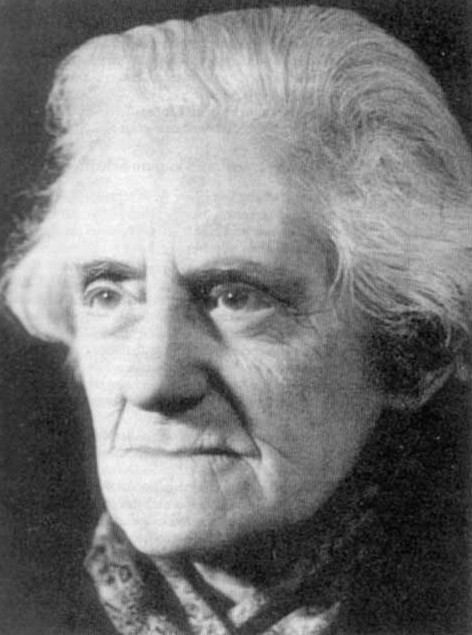
Fig. 3: Nelly Wolffheim, around 1960; Ida-Seele-Archive (ISA), 894071 Dillingen.
Wolffheim’s interviewees, primarily German-speaking Jews who had fled Nazi Germany before or during the war, ranged in age from thirty-eight to eighty-six years old at the time of their interviews. Considered together, her interviews reveal themes of concern to Wolffheim. She focused on age, class, and gender – particularly women’s experiences – in relation to flight from persecution and survival, as well as the loss of professional status, “privilege” (such as “mixed” marriages), and the psychological torment experienced by victims. From these accounts, Wolffheim aimed to chronicle the lives of other older women in her community with whom she shared affinities, empathy, friendship, and intimacy – reinforcing the dignity and inherent humanity of older German-Jewish refugees.
One example is the brief interview with two sisters, Betty and Jenny Student. They were fifty-seven and fifty-six years old at the time of their emigration to England, and Wolffheim interviewed them in German in 1958 in the Schiff home when they were seventy-six and seventy-five. Their report, written in Wolffheim’s voice, demonstrates that Wolffheim was especially concerned about women’s earning capacity and financial independence, and that she believed that some German Jews were naive in the face of increasing Nazi persecution. The two sisters had run a textile shop in Giessen that they sold (“voluntarily”, as Wolffheim underlined) in 1936 after non-Jews were forbidden from shopping there.
Like other Jewish refugees, the Student sisters found refuge thanks to family contacts. Between 1933 and 1945, around 80,000 refugees from the German-speaking lands had fled to Great Britain, the vast majority of whom were Jewish. Over 20,000 refugees, mainly women, were able to immigrate by securing a domestic service job. The Student sisters visited their brother in London, and, not seeming “fully aware of the seriousness of their situation”, returned to Giessen in January 1938. Their brother tried to convince them to stay, but, as Wolffheim described empathetically, financial considerations held sway: “they did not want to stay in England as they dreaded the dependence and believed they would somehow make a living in Giessen through working from home or something similar.” After the November pogroms in 1938, the danger became clearer, and they left Giessen in January 1939. Yet their brother’s financial support still troubled them, according to Wolffheim, twenty years later during their interview, which demonstrates how many refugees struggled financially; as Wolffheim noted, “even when they talk about it today, you can see how difficult it was for them to accept [their brother’s help].”
The cover sheet for this account reinforces Wolffheim’s view that people who made decisions like the Student sisters, returning to Germany after leaving temporarily, showed “how guileless many Jews remained for a long time.” The eyewitness account is therefore not only a brief chronicle of the sisters’ escape, their struggle for independence, but also a snapshot of shared and evolving perspectives of German-speaking Jewish refugees who were forced to flee, who made decisions in different circumstances and contexts and who reflected on their choice to leave Nazi Germany. Due to her professional background, Wolffheim focused, too, on the psychological motivations of the sisters. The reports can therefore also be seen as evidence of how her expertise and knowledge of the psychoanalytic discipline were applied to the task of interviewing and crafting reports for the Wiener Library.
The Eyewitness Accounts collection highlights the important yet under-researched role of German-speaking Jewish women in postwar documentation efforts. In general, women were overrepresented in postwar documentation efforts, but their roles are often marginalized, as they were less likely to hold high-profile positions in historical commissions and were not always professional historians or academics. The ‘behind-the-scenes’ archival and administrative work they performed was, however, vital to the creation of these collections and institutions. Examining the role of the interviewers in crafting the accounts further shows the transfer across borders of cultural, professional, and other knowledge, such as personal confrontations with forced migration, and how this knowledge was reshaped and applied to archives-building at a diasporic German-Jewish institution in postwar Britain. The digital repository, Testifying to the Truth, where the digitized eyewitness accounts are translated and reproduced, allows users to search across and beyond the original classification conceived of by Reichmann and her colleagues. Although this technology was unforeseen by the archive’s creators, the digital repository presents opportunities for thematic searches and reordering of the collection, prompting new insights into the social and cultural networks of the German-Jewish diaspora that underpin the creation of this collection.
Testifying to the Truth: Eyewitnesses to the Holocaust. The Wiener Holocaust Library: https://www.testifyingtothetruth.co.uk/viewer/
Online launch event: Wiener Digital Collections, The Wiener Holocaust Library, 2025: https://youtu.be/TWEwCkPzZig
Wiener Digital Collections, The Wiener Holocaust Library: https://twlmapviewer.intranda.com/index/
Astrid Kerl-Wienecke, “Nelly Wolffheim”, The Shalvi/Hyman Encyclopedia of Jewish Women: https://jwa.org/encyclopedia/article/wolffheim-nelly
This work is licensed under a Creative Commons Attribution - Non commercial - No Derivatives 4.0 International License. As long as the material is unedited and you give appropriate credit according to the Recommended Citation, you may reuse and redistribute it in any medium or format for non-commercial purposes.
Dr. Christine Schmidt (https://christineeschmidt.com/) is the Co-Director of The Wiener Holocaust Library in London. Her research has focused on the history of postwar tracing and documentation efforts, the concentration camp system in Nazi Germany, and comparative studies of collaboration and resistance in France and Hungary, and she is currently writing a social history of the Wiener Library’s postwar collecting of eyewitness accounts led by Eva Reichmann.
Schmidt has recently published articles in the Journal of Transport History, the European Review of History, American Imago, Culture Unbound, and The Journal of Holocaust Research, and is co-editing Letters and the Holocaust: Methodology, Cases, and Reflections (Bloomsbury, 2025); Survivors of Nazi Persecution - Beyond Camps and Forced Labour (Palgrave, 2024) and Older Jews and the Holocaust (Wayne State UP, 2026).
Christine Schmidt, Postwar Documentation Efforts of the German-Jewish Diaspora: The Wiener Library’s Eyewitness Accounts Collection in London, in: (Hi)stories of the German-Jewish Diaspora, March 15, 2026. <https://diaspora.jewish-history-online.net/article/gjd:article-54> [September 18, 2026].
 This work is licensed under a Creative Commons Attribution - Non commercial - No Derivatives 4.0 International License. As long as the material is unedited and you give appropriate credit according to the Recommended Citation, you may reuse and redistribute it in any medium or format for non-commercial purposes.