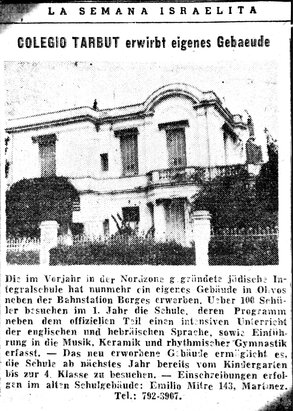
The source is a short newspaper article titled “Colegio Tarbut erwirbt eigenes Gebäude” (“Colegio Tarbut Acquires Its Own Building”), published in 1961 in Jüdische Wochenschau / La Semana Israelita, the main German-language periodical for the Jewish immigrant community in Argentina. Illustrated with a photograph of the new building, the article announces that Colegio Tarbut (Tarbut School, hereafter referred to as Tarbut), a recently founded integrative Jewish school in the northern zone of Buenos Aires, had acquired its own building in Olivos, near the Borges train station. It reports that more than 100 students were already enrolled and outlines the school’s curriculum, which combined official Argentine subjects with intensive instruction in Hebrew and English, along with music, ceramics, and rhythmic gymnastics. It also mentions that starting the next academic year, the school would expand to include students from kindergarten through fourth grade. Enrollments were to be completed at the school’s previous location on Emilio Mitre 143 in Martínez.
Tarbut had been founded earlier that year by a group of mostly German-speaking Jewish parents in Martínez neighborhood. The school’s establishment was promoted through newspaper ads and community networks. An example of this can be seen in the source from the Jüdische Wochenschau/La Semana Israelita, which featured promotional announcements for the school. When the periodical first appeared in 1940, it quickly became the main forum for the German-speaking Jewish community in Buenos Aires. For refugees who still struggled with Spanish, it provided news, cultural commentary, community-building, and a vital link to Europe, while helping readers adjust to life in Argentina. Tarbut’s Board of Directors used this platform strategically to reach families in the émigré community, presenting the school as a modern alternative within the Jewish educational landscape.
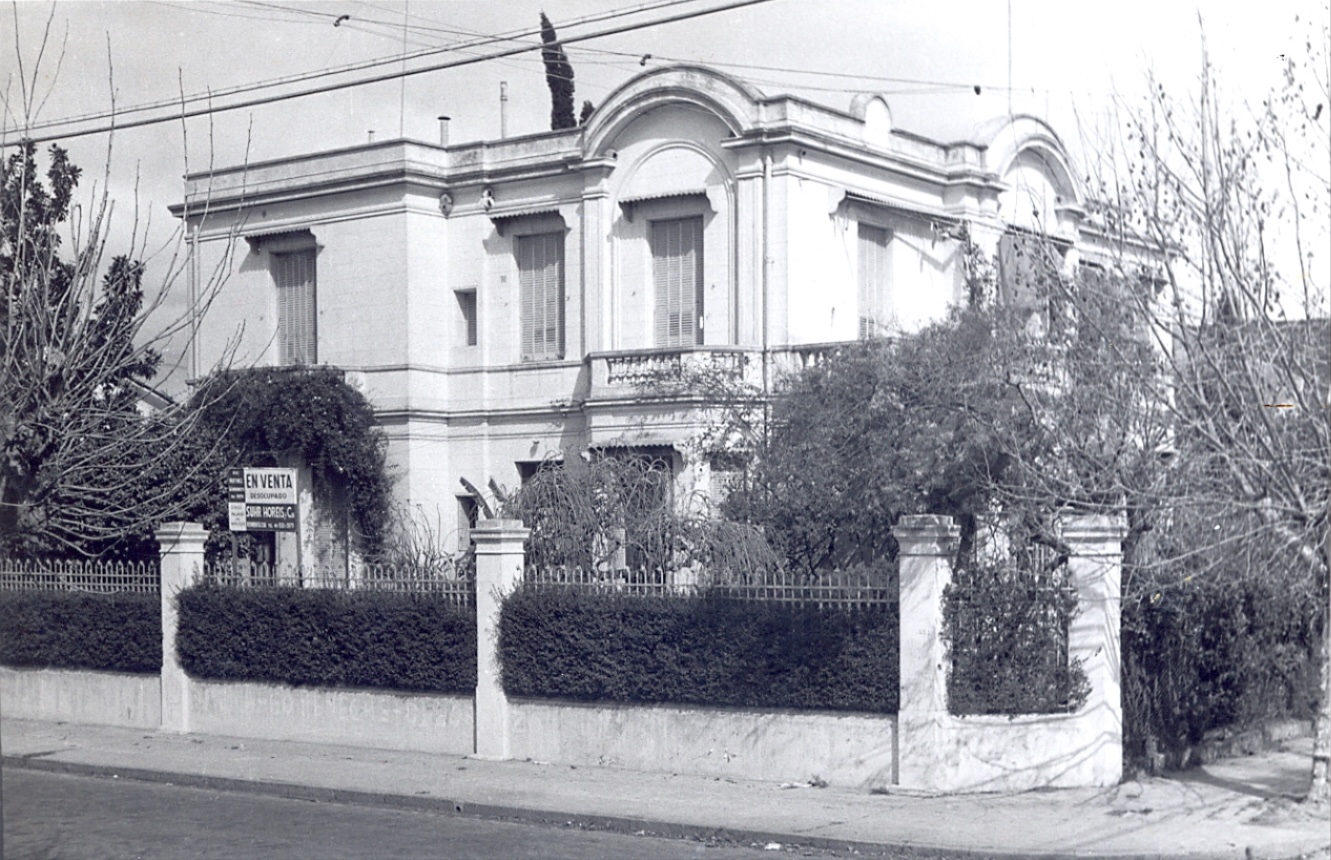
Fig. 1: Tarbut’s recently opened primary school building on Rawson Street, 1961; Family Archive Lubasch.
From 1933 to 1940, Argentina became home to a new wave of Jews coming from German-speaking countries. According to historian Haim Avni, an estimated 32,000 to 40,000 Central European Jews immigrated during this period, fleeing Nazi-occupied Europe. While many settled in Buenos Aires’ established Jewish neighborhoods such as Once or Belgrano – the principal hub for German-speaking Jewish settlement – a few of the refugees formed new communities on the outskirts of the city, particularly in the Vicente López neighborhood. This movement coincided with a gradual but steady move of other Western European migrants, primarily British and German, to this area.
In May 1944, the Asociación Religiosa y Cultural Israelita Lamroth Hakol (later known as Lamroth Hakol), a German-speaking liberal synagogue, was established in that area. In its early years, services were conducted in German, with Hebrew spoken using the Ashkenazi pronunciation. This was largely because many refugees found it difficult to adapt to Spanish. The melodies used in the services reflected the familiar tunes they had sung back in Europe, maintaining a strong connection to their cultural roots.
After a few years, Rabbi Paul Hirsch (1914–1979) from Aachen, who had taken refuge in Bolivia, became the synagogue’s rabbi. Meetings were organized to introduce young couples to Judaism. Participants included Dr. Walter (Gualterio) Lubasch (1923–2004), a board member of the institution, who, in September 1938, arrived in Buenos Aires with his parents, having left Vienna shortly after the so-called Anschluss. Together with his wife, Marianne Lubasch (1923–2016), also a German-speaking Jewish refugee, they raised a son, who began his education at St. Peter’s School and transferred to the British St. Andrew’s Scots School in 1960.
Although the German liberal Pestalozzi School, located in Belgrano, was an option, the Lubasch family preferred their son to learn English. Despite several German schools in the city, the Pestalozzi School stood as one of the only viable options for these refugees, as Nazi ideology had spread through much of the German-speaking Argentine school community during the 1930s and 1940s. It was the sole institution whose administration actively resisted Nazi influence on their children’s education. However, fluency in English was becoming a significant asset in the global arena, both in business and culture, as English consolidated its position as the international language. Many German Jewish parents valued this skill, viewing it as a key to their children's future success in an increasingly globalized world. They believed it would help their children integrate more easily into Argentine society. While many refugees continued speaking German at home, enabling their children to learn the language and its cultural heritage, others felt the need to sever ties with anything that reminded them of their lost homeland.
At that time, several private schools in the Vicente López and San Isidro neighborhoods offered a variety of cultural and educational models, often with gender segregation. Girls typically attended schools like Northlands or St. Catherine’s, while boys went to institutions such as St. Andrew’s Scots School, the co-educational Lincoln, or St. Peter’s. There were only two Jewish schools in the area, the Scholem Aleijem operated under the auspices of the Vaad Hajinuj, the education department of Asociación Mutual Israelita Argentina (AMIA, the central umbrella institution of Jewish communal life), dedicated to supporting Jewish education in the country. These schools’ curricula were taught in Yiddish, a language that didn’t resonate with German-speaking Jews. Additionally, the recently founded (1959) Colegio Bene Israel targeted a Sephardic audience. As a result of these gaps in Jewish educational offerings, many families chose to send their children to British, German, or French schools, thereby enriching the cultural tapestry of the educational landscape.
Established in 1838 by a group of Scottish settlers, St. Andrew’s Scots School sought to harmonize Christian faith and observance with academic excellence. To that end, in 1960, a letter was sent to the parents announcing that school days would begin by reciting the Lord’s Prayer, “a prayer accepted by all Christians.” Arthur Bryant, Escuela Escocesa San Andrés (Escuela Escocesa San Andrés, 1960), document in possession of the author. It was suggested that students of other faiths stay in their classrooms. For parents who had immigrated to Argentina seeking refuge from persecution, such discrimination felt all too familiar, but this time, they were determined not to submit to that rule.
The Lubaschs voiced their concerns to the school board, protesting this requirement and suggesting the inclusion of a rabbi to teach Jewish values and history to the children. Despite their efforts, all their requests were denied.
Concerned about their children’s Jewish education, a group of young parents in Lamroth Hakol began discussing possible alternatives. Lubasch approached Rabbi Hirsch to suggest including Jewish teachings in the curriculum at St. Andrews Scots School during prayer hour. After this proposal was rejected by the school board, Lubasch conceived the idea of creating a comprehensive Jewish school that would teach Hebrew, English, and Spanish. He envisioned a school that would offer a first-class, modern, and dynamic education. According to Rabbi Hirsch, it was an impossible mission, and he even bet that this fantasy was impractical. Therefore, we can say that Tarbut was the outcome of a bet between two leading members of the community.
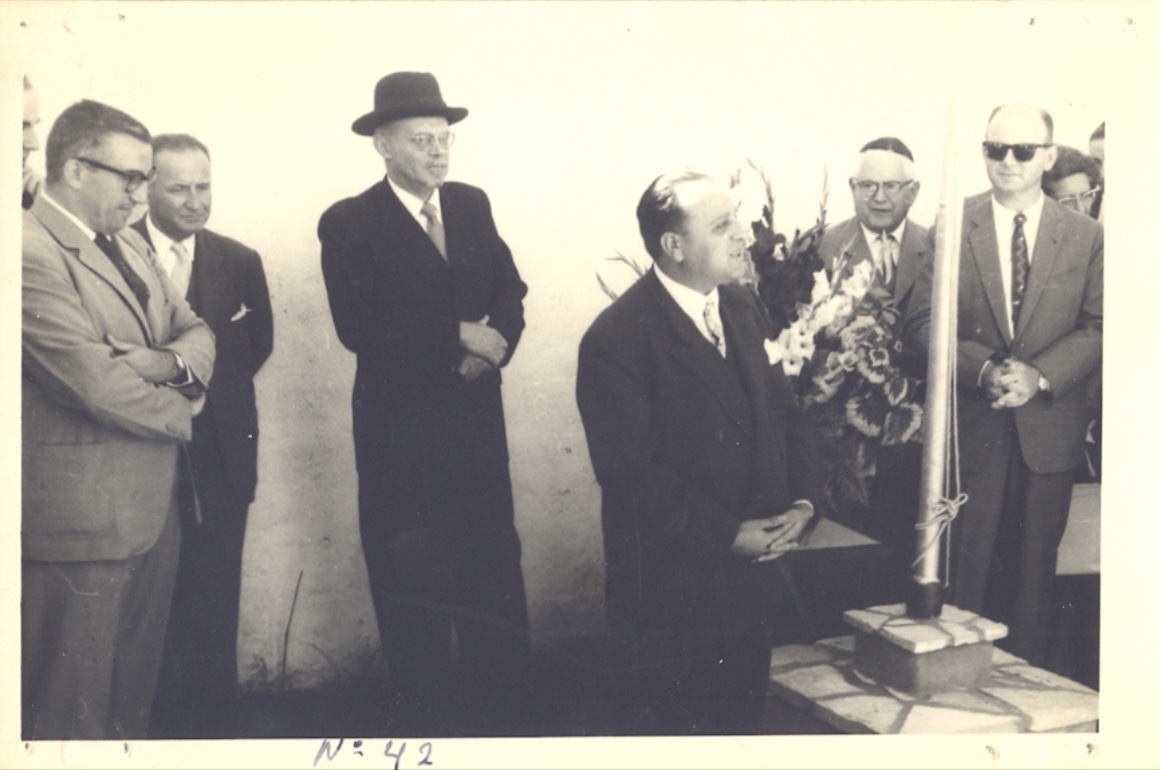
Fig. 2: Walter Lubasch (fourth from left), one of the driving forces behind the school’s founding, speaking at its inauguration in 1961, surrounded by other members of the founding community, including Alfredo Weil (far left); Family Archive Lubasch.
A committee of young parents was established in Lamroth Hakol to carry out a feasibility study. On July 26, 1960, a Constituent Assembly was held at the synagogue, where a “Declaration of Principles” was presented and agreed upon by the committee. It was clear to the founders that the school would provide Jewish education with a focus on the future, teaching traditions, without transforming the school into a synagogue. That the school would provide an exclusively Jewish education was never their aspiration; they firmly believed that it was necessary to impart an Argentine national education that included language, mathematics, science, Argentine history, and geography.
This curriculum differentiated them from schools under the direction of the Vaad Hajinuj, as these only offered Jewish content. Teaching English was of utmost importance for the founders, considering it the world’s lingua franca. Soon after its establishment, the founding members gradually withdrew from synagogue activities to dedicate themselves fully to the demanding task of building the new institution. They laid the foundation for a new venture that was to impact not only the students and schools of the area but also the Argentine Jewish school network. Tarbut’s educational approach represented a significant departure from the prevailing norms within the Jewish educational system. Not only did it introduce a novel curriculum, but it also implemented a distinct curricular framework.
A Pedagogical Committee was formed to develop a comprehensive, humanistic educational program aligned with the school’s academic goals. The committee included Walter Lubasch, Iris May (1923–2018), Engineer Mauricio Rozenwasser (1921–2000), and Dr. Alfredo Weil (1925–1974), most of them Central European immigrants, reflecting the school’s refugee background. It aimed to create an integrated curriculum across the three language levels – Hebrew, English, and Spanish – ensuring continuity and emphasizing inquiry-based learning. Working closely with a team of educators, the committee designed a modern curriculum tailored to the students’ needs.
The school opened its doors in 1961 in the Martínez neighborhood, with Martin Braniss (1916–2007) serving as its inaugural president. Its name was Colegio Albert Einstein. Much to the surprise of the board members, a few months later, they received a telegram from another school with the same name in the city demanding a name change and threatening legal action for the unauthorized use of their school's name. In response, the Board then renamed it Colegio Tarbut, the Hebrew word for culture.
Shaped by a liberal German-Jewish tradition, the founding parents envisioned a school that would blend academic excellence with Jewish values and a comprehensive, universal cultural education – a vision reflected in the school’s trilingual model and rooted in a desire for openness rather than isolation. The project attracted several families from the area and the adjoining Federal District. Many of the first students were children of Jewish refugees from Europe, though not all came from that background. The student body expanded from 80 in the first year to 330 in 1962. Moreover, it moved from offering only first and second grades to the fifth grade.
From the very beginning, the school employed teachers of every faith. The only requirement was their ability to teach. This also set Tarbut apart from the Vaad Hajinuj schools, which hired only Jewish teachers. In contrast to numerous educational institutions, Tarbut boasted a unique ownership structure where the parents themselves held the reins. This innovative approach was driven by the founders' desire to foster a deep sense of parental commitment both to their children’s education and to the institution itself. Since its foundation, the institution’s leaders aimed for a truly ‘integral’ school, the first trilingual school in the country, where all sections complemented each other.
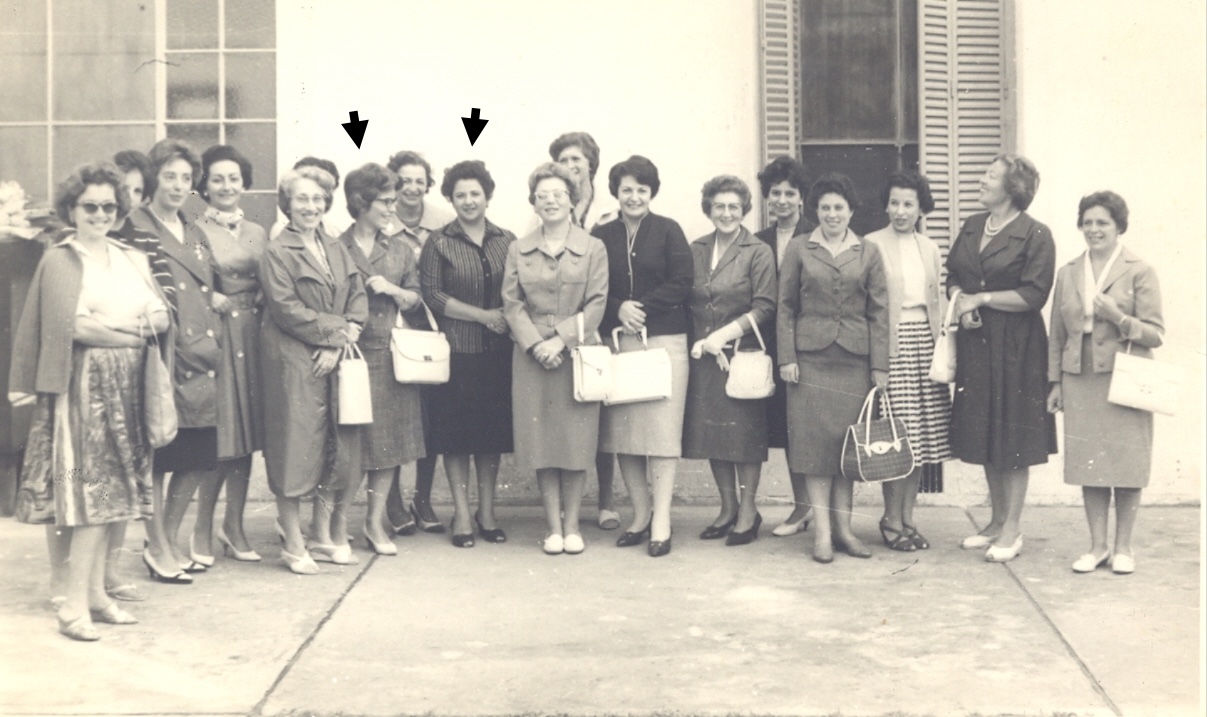
Fig. 3: Female members of the Comisión Directiva (Board of Directors) of Colegio Tarbut, around 1961, including Iris May (seventh from left) and Marianne Lubasch (ninth from left); Family Archive Lubasch.
Classes were small in order to maximize educational efficiency during the eight hours students attended the school. Hebrew and English instruction began in kindergarten, with hours dedicated to English language and culture studies matching those for Jewish studies. In the afternoon, the national curriculum was taught in Spanish. School critics argued that transitioning to a full-day schedule would threaten the harmonious interaction between Jewish and non-Jewish students, labeling it a form of ghettoization. This was precisely what the founders wanted to avoid; they rejected the idea of isolation as sterile and sought a productive dialogue with the non-Jewish Argentine community.
To prevent a different kind of isolation, a scholarship subcommittee, led by Marianne Lubasch, was established to support outstanding students whose families faced challenges in covering the school’s expenses. In the early years, support from various community institutions was sought to establish these scholarships. Initially, only two German-Jewish organizations, Lamroth Hakol, and Bene B’rith – Tradición, were able to help. In 1963, Tarbut began providing about 20 scholarships annually to students from modest backgrounds. This marked the beginning of Tarbut’s continuous effort to support families facing financial difficulties.
In opposition to the rigidity and authoritarianism of traditional schooling, Tarbut also avoided the use of physical punishment common in other institutions. The goal was “an order in harmony, where each individual’s rights are respected and where individuals, in turn, must respect the rights of both classmates and superiors” Colegio Tarbut, El "Colegio Tarbut": Una escuela integral judía en marcha (Buenos Aires: Asociación Judeo Argentina de Cultura y Educación, 1962).. Iris May, director of the primary school, introduced the American pedagogical model inspired by the Summerhill School, which advanced a progressive, student-centered philosophy that rejected authoritarian forms of instruction. In this model, teachers act as facilitators who prioritize students’ well-being, encourage self-reflection, self-regulation, and personal responsibility.
The influx of German-speaking Jews introduced a Central European Jewish culture to the already diverse tapestry of Eastern European and Sephardic communities, who had established themselves in the country much earlier. This addition brought new complexities, further deepening the existing divisions between Jews and between religious and secular factions, which were further exacerbated by internal differences within these groups (Eastern European and Western European or Middle Eastern and North African). While the German-speaking Jews generally remained within their own community, the founders of Tarbut saw an opportunity to reach beyond these confines. The founders deemed it crucial that the inaugural board include members from both Ashkenazi and Sephardi backgrounds, thereby bridging the divide among Jewish students who typically attended schools within their respective communities. By successfully achieving this goal of integration, the future board of directors gradually moved away from the school’s original German-Jewish distinctiveness.
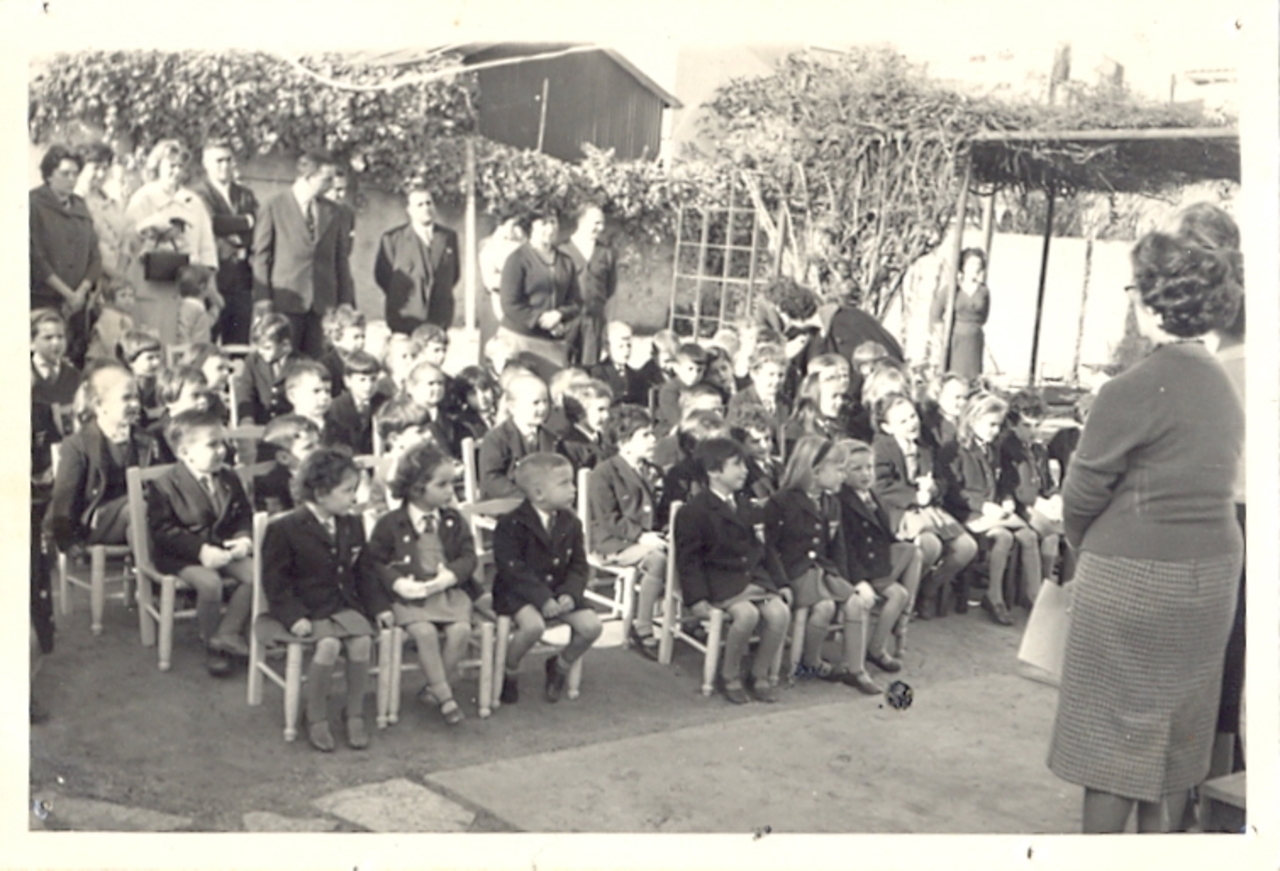
Fig. 4: Students and teachers, with parents standing in the background, at the Colegio Tarbut, Buenos Aires, 1961; Family Archive Lubasch.
As Walter Lubasch emphasized in 1968, Tarbut was conceived as a democratic, parent-led institution that integrated Jewish and general education within the framework of Argentine society.
In summary, Tarbut and the German-speaking Jewish community coexisted within distinct spaces, such as German-speaking synagogues, yet remained connected within the broader Jewish ecosystem through shared educational and cultural values. Over time, these distinctions faded as Jewish life in Argentina became more integrated into the wider society. Today, Tarbut continues to operate as a trilingual Jewish school. While it maintains its Jewish identity, the specifically German-Jewish heritage that marked its origins no longer plays a visible role, as the school has become firmly integrated into Argentine society. Unlike in 1961, when the founding committee advertised in German to reach the émigré community, such an announcement would no longer appear in that language today.
Colegio Tarbut official website: Colegio Tarbut
Mauricio Zabelinsky, ¿Era necesario el Tarbut?, Revista Tarbut 25 aniversario, 1988.
This work is licensed under a Creative Commons Attribution - Non commercial - No Derivatives 4.0 International License. As long as the material is unedited and you give appropriate credit according to the Recommended Citation, you may reuse and redistribute it in any medium or format for non-commercial purposes.
Irene Munster holds a master’s degree in library and information science from the University of Illinois Urbana-Champaign. She started her career as a librarian in Buenos Aires, initially at the Seminario Rabínico Latinoamericano and later at the Universidad de San Andrés. In 2004, she moved to the United States, where she worked at the libraries of Duke University, the Inter-American Development Bank, and currently works at the Universities at Shady Grove/University of Maryland Libraries. Her research focuses on German-speaking Jewish emigration to South America as well as Jewish libraries and bookstores, and her articles have appeared in peer-reviewed journals.
Irene Munster, When a Bet Became a School: Immigrant Vision and the Founding of Colegio Tarbut in Buenos Aires, in: (Hi)stories of the German-Jewish Diaspora, January 06, 2026. <https://diaspora.jewish-history-online.net/article/gjd:article-47> [October 08, 2026].
 This work is licensed under a Creative Commons Attribution - Non commercial - No Derivatives 4.0 International License. As long as the material is unedited and you give appropriate credit according to the Recommended Citation, you may reuse and redistribute it in any medium or format for non-commercial purposes.