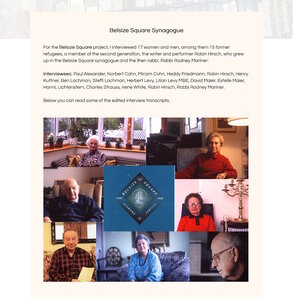
This article highlights the importance of Belsize Square Synagogue (BSS), founded in 1939 in London and, from 1940, known as the New Liberal Jewish Congregation, for the German-Jewish refugee community in the UK. The congregation provided a space of community and mutual understanding for its members with a specific sense of religious, cultural, and intellectual continental continuity.
My findings are based on interviews conducted in the year 2000, when a substantial number of first-generation German-speaking Jewish refugees were still actively involved in the BSS. Most of those interviewed were either founding members or had family members who were closely involved from the start. A few joined later – in the 1940s, 1950s, and 1980s. The interviewees’ ages ranged from the early 70s to over 90, with years of birth spanning from before 1910 to the early 1940s. Most interviewees came from Berlin, with others from cities such as Hamburg, Frankfurt, and Freiburg. Interviews were conducted primarily in people’s homes and lasted between one and four hours. Using an open oral history approach, I allowed conversations to develop naturally, but BSS consistently emerged as a central theme. All interviews were conducted in English.
When I started interviewing members from the synagogue, I was looking for the signs that link BSS of today to the past of its founders, who were all Jewish refugees, mostly from Germany. In the interviews, my impression was not that of discontinuity and loss but of continuity and change. I suggest that the BSS community is perceived as the ‘cultural heir’ by the refugee generation, which gave its members a link to the past and the future.
The first service of what would become Belsize Square Synagogue was held on 24 March 1939. It was organised by Jewish refugees, mainly from Berlin and Frankfurt, who had recently arrived in the UK. Without a formal congregation, services were led by various rabbis and cantors. Supported by Lily Montagu (1873–1963) – founder of the English Liberal Movement and lay minister at the Liberal Jewish Synagogue – the group held Friday night services at Montefiore Hall (which was part of the Liberal Jewish Synagogue in St. John’s Wood). However, they found English Liberal Judaism too radical and could not integrate into existing synagogues like other refugee groups.
In June 1939, they formally established the New Liberal Jewish Association, which was renamed Belsize Square Synagogue in 1971. Initially based in rented rooms in Swiss Cottage, the community moved in 1951 to a converted vicarage on Belsize Square. Over time, the building evolved into a modern synagogue with seating for over 1,000 people.
The synagogue has had only a few rabbinic changes: Rabbi Dr. Georg Salzberger (1882–1975), who had served as a rabbi in Frankfurt, was succeeded in 1956 by another German-Jewish refugee, Rabbi Jakob Kokotek (1911–1979), who had studied in Breslau (Wrocław). In the early eighties, Australian-born Rabbi Rodney Mariner (1941–2024) was appointed, followed by two American rabbis: first, Rabbi Dr. Stuart Altshuler (*1953), and from 2021, Rabbi Gabriel Botnick (*1981). Cantor Magnus Davidsohn (1877–1958), formerly Oberkantor of the Fasanenstrasse Synagogue in Berlin, was followed by Cantors Joseph Dollinger (1907–1998), Louis Berkman (1934–1993), Lawrence Fine (*1942), Norman Cohen Falah, and, from 2013, by Paul Heller.
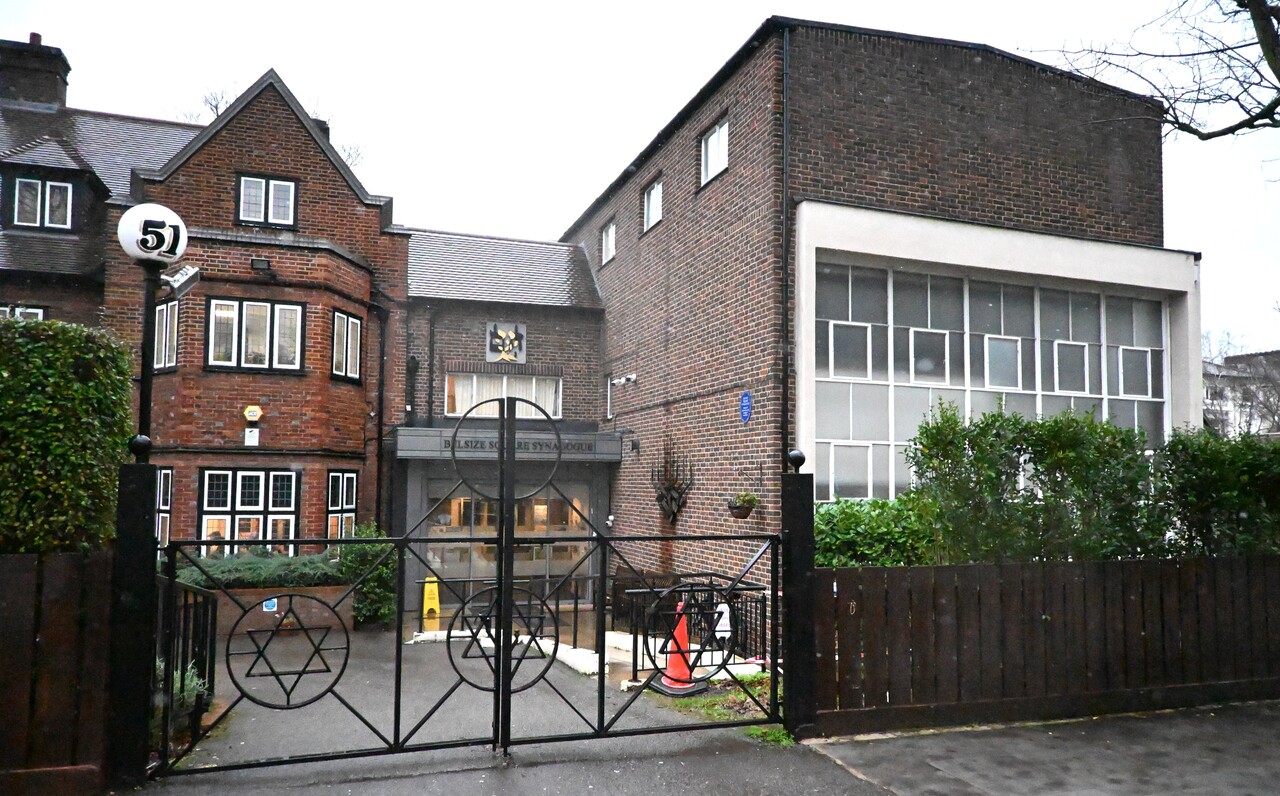
Fig. 1: Belsize Square Synagogue, view from the outside, January 2026; by courtesy of Bea Lewkowicz.
In 2025, the community has 1173 members and is housed in a building in Belsize Park, an affluent part of north-west London. Above the entrance to the synagogue is a sign that reads Etz Chaim (‘Tree of Life’ in Hebrew), which is the name the community adopted in 1989. The Friday evening and Saturday morning services are well attended, and on Sunday morning every available room is filled with children who study at the Belsize Sunday school.
This could be a description of any thriving Jewish community in London, but if you look a bit closer, you find specific references to the community’s history. In the entrance hall, just before you step into the synagogue, you can see a piece of glass in a frame, commemorating the November pogroms of 1938. But even more poignant is the emblem of the community, which is printed on all prayer books, a two-branched tree with roots, one strong and upright with branches and many leaves, the other one cut off. The community has adopted the name Etz Chaim, which reflects its continental origins growing from an ancient stock that so nearly perished in the horror of the Shoah. The weak sapling of 1939, which was planted by refugees from Germany and Central Europe, has burgeoned into a tree of considerable stature – free-standing and proud.
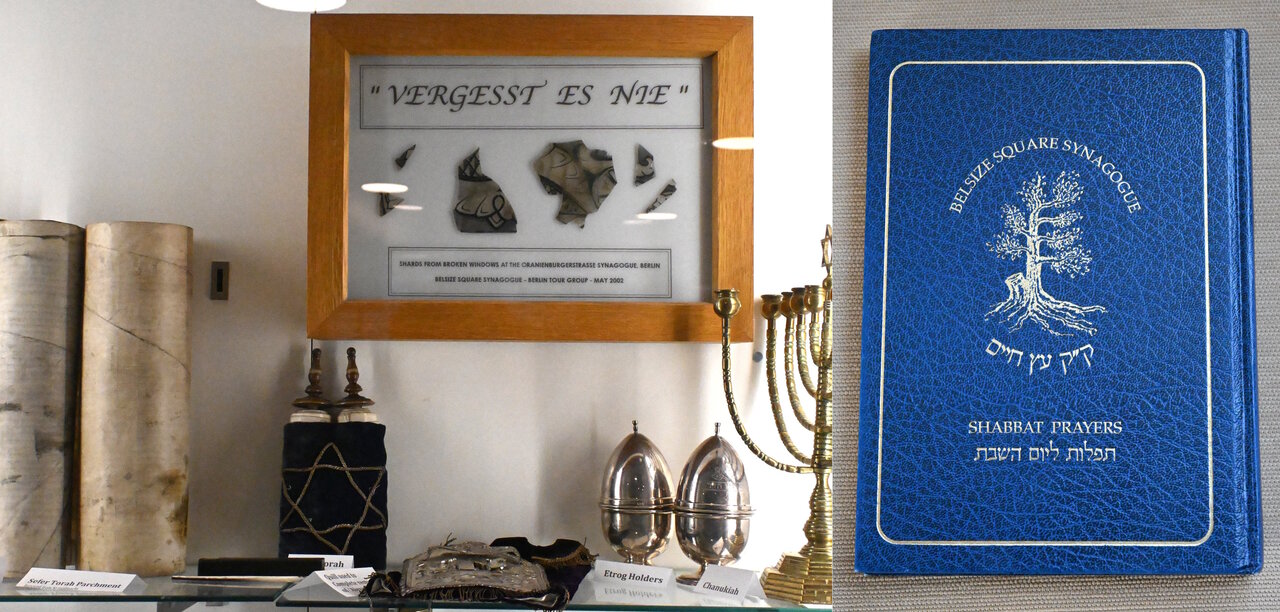
Fig. 2 and 3: Display case in the entrance hall of the synagogue and the cover of the Shabbat prayer book; by courtesy of Bea Lewkowicz.
Two interviewees, Charles Strauss (*1908 in Frankfurt), and Heddy Friedmann (*1909 in Hamburg) were born before 1910. Their memories are of relevance because they can best convey what the founding of the New Liberal Congregation meant for adults forced to flee from Nazi Germany. Friedmann, who came as a refugee to the UK in 1938, became involved in the Belsize Square Synagogue in the late 1950s upon returning from the British colony of Nigeria with her husband and children.
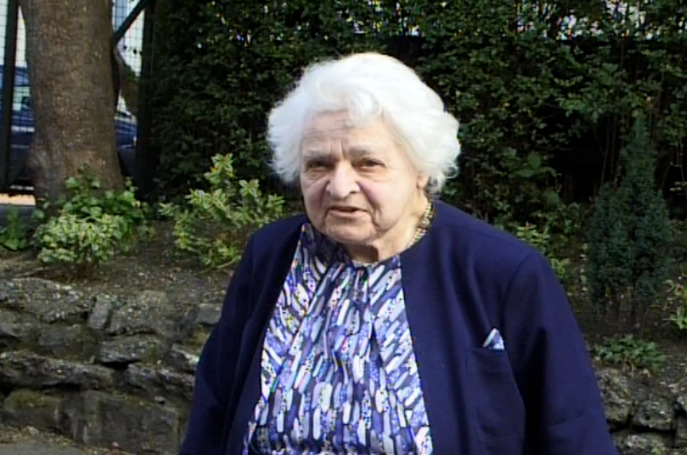
Fig. 4: Heddy Friedmann (1909–2007), outside BSS, 2000. She was interviewed on 20 March 2000; by courtesy of Bea Lewkowicz.
Several younger interviewees remarked that many people who should have been interviewed had already passed away. At the end of his interview, Strauss reflected on memory and forgetting:
“I am thinking of all those who had been working for Belsize Square. […] It’s a great pity that in the end they are forgotten. I also think that our German past, our history, will be, to a very large extent, forgotten. So, I have perhaps done some good in giving this interview.”
This statement reveals the connection, for Strauss, between the German past and the history of BSS. The synagogue’s presence offered a way for the German-Jewish past – cut short in Nazi Germany – to live on. Strauss, like many of his generation, came to Britain alone; his parents and other relatives perished in the Shoah. Founding the New Liberal Jewish Congregation helped establish continuity for people who had suffered dramatic ruptures in their lives – loss of family, profession, language, and social status.
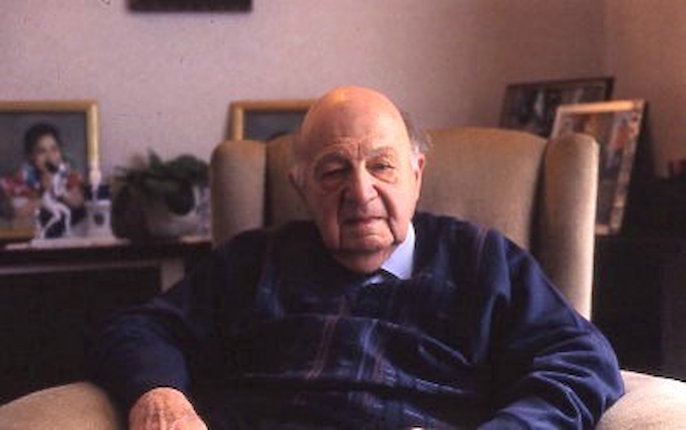
Fig. 5: Charles Strauss (1908–2001), photographed at his home. He was interviewed on 10 February 2000; by courtesy of Bea Lewkowicz.
Charles Strauss reflected on his own experience as a refugee: “I was already one of the older ones in 1937, I was nearly 30. This was an advantage and a disadvantage. The younger ones got further in life here. Their English became better, some of them went to school here. They were not formed to such an extent yet.”
This quote highlights how age affected the refugee experience. Younger émigrés often adapted more easily. For older individuals who had left behind careers and struggled with language, it was critical to form new connections in Britain.
The theme of ‘connections’ recurred in many interviews when discussing the Belsize Square Synagogue. For Charles Strauss’s generation, creating a refugee synagogue not only provided spiritual continuity with synagogues left behind but also personal familiarity. Strauss had studied under Rabbi Dr. Salzberger in Frankfurt, who later helped establish BSS and became its first rabbi. Strauss recalled: “The synagogue for me became a renewal of the Freiherr-vom-Stein-Strasse. […] As I told you, Rabbi Seligmann married my parents in 1906. And Rabbi Salzberger was my teacher at the Musterschule; he came every week.”
This continuity of spiritual leadership between Germany and Britain gave comfort to many. Other interviewees, like Herbert Levy (*1929 in Berlin) and Irene White (*1917 in Dessau), recalled encounters with Oberkantor Magnus Davidsohn, the congregation’s first cantor, who had served at the Fasanenstrasse Synagogue in Berlin.
Renate Stern (*1922 in Berlin), trained as a nurse, said of BSS’s services: “It was really a relief to have these services that could have been held in Frankfurt or in Germany.” She later described the services as “the last little link to our upbringing.” For Stern and others, liturgical continuity provided solace amid the upheaval of migration.
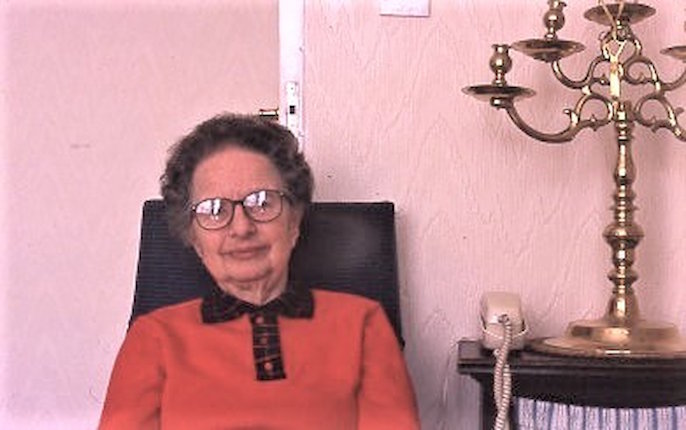
Fig. 6: Renate Stern (1922–2006), photographed at her home. She was interviewed on 13 April 2000; by courtesy of Bea Lewkowicz.
Paul Alexander (*1917 in Berlin) shared the story of his family’s Torah scroll, dating back to the late eighteenth century. This scroll, spared during the November pogroms of 1938 because it was kept at home, became the first Torah scroll used by the New Liberal Jewish Congregation in Britain.
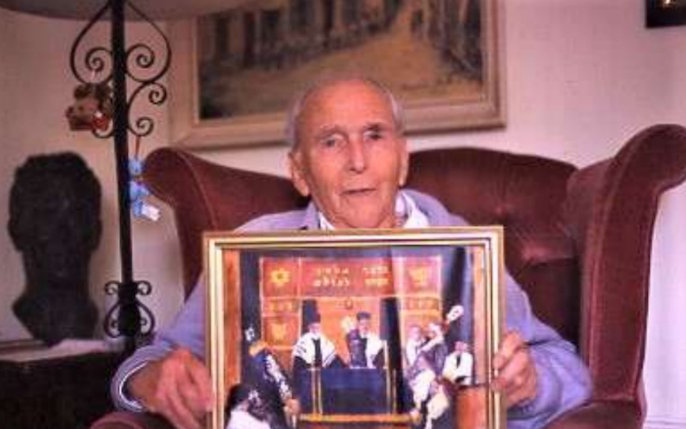
Fig. 7: Paul Alexander (1917–2003), with a photograph of his family’s Torah scroll being used in a service of BSS. Alexander joined the synagogue in 1939. He was interviewed on 22 May 2000; by courtesy of Bea Lewkowicz.
On the occasion of the tenth anniversary of its magazine Our Congregation, Rabbi Dr. Leo Baeck (1873–1956), who settled in London after the Second World War, emphasised Belsize Square Synagogue’s important role as a family-like community: “The Congregation is the family of families, a joint home […]. Guide especially is given to he who has come from another land […]. The deeper one roots in his congregation as well as his family, the broader he will take root in town and country.”
When asked about changes in the BSS community, Rabbi Rodney Mariner, who served as rabbi from 1982 to 2011 and as Emeritus Rabbi until his death in 2024, observed: “It was rather a friendly society that contained a synagogue. Now it is a synagogue trying to maintain a number of different interest groups within it.” This reflects a broader shift from a cultural institution to one with deeper religious engagement.
Many interviewees, however, did talk about the importance of continuity of religious practice. Most had grown up in liberalen synagogues in Germany. For example, one couple insisted on following the Berlin wedding custom of walking in together and not breaking a glass under the chuppah. Music played a key role in religious identity, which for many represented an enduring connection to the German-Jewish liberale tradition. One interviewee described music as “the most important aspect of belonging […] because that will last.”
BSS separated from the UK Liberal Synagogue Movement in 1989 and became an independent progressive synagogue. For many, the synagogue was a place of ‘enlightened worship,’ where they were surrounded by like-minded people. Ben Lachmann (1924–2019), long involved in liturgical affairs, explained that BSS services appealed across religious preferences: “We have something that pleases the more traditional and the progressive […] sitting together and having decorum […]. It is more in the Yekke tradition.” Lachmann, who came to the UK from Israel, emphasised: “I didn’t want to float […], I wanted to belong […], one has to maintain an identity.”
A dominant theme across all interviews – regardless of age – was that the Belsize Square Synagogue became a substitute for ‘home.’ Irene White, who had fled from Berlin to London, captured this sentiment: “Having lost a home and a background and having lost trust, you found that you were not on your own.” Henry Kuttner (*1929 in Berlin), who was nine when BSS was founded, recalled early services: “There was a feeling of togetherness and at-home-ness which was indispensable for people who had everything taken from them except their lives.” He emphasised that music and German-language services created a sense of familiarity. Kuttner continued to play an important part in the musical life of BSS for all his life.
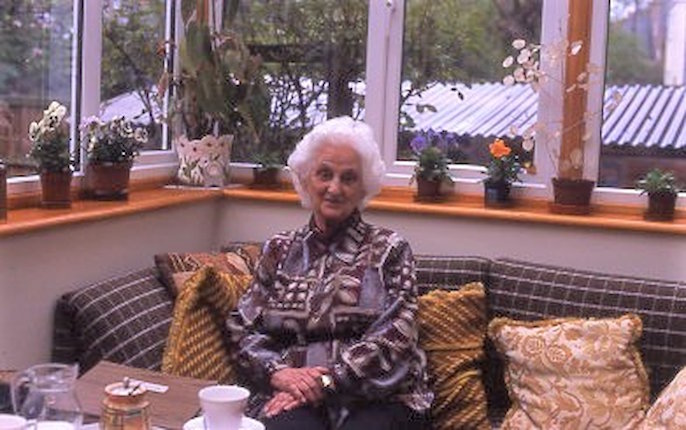
Fig. 8: Irene White (1917–2016), photographed in her home. She was interviewed on 25 April 2000; by courtesy of Bea Lewkowicz.
Beyond worship, the Belsize Square Synagogue provided cultural life through regular events such as concerts and lectures. Herbert Levy recalled: “There were many refugee artists […], Die Zauberflöte, Die Fledermaus […]. It was our cultural life. Nobody could afford theatre or concerts, so this was the cultural upbringing I had.”
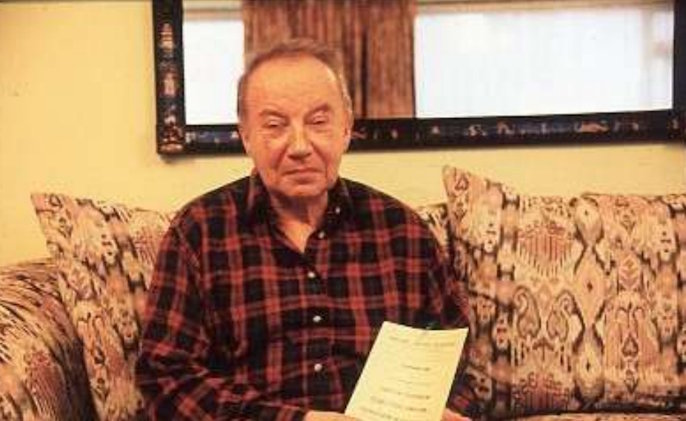
Fig. 9: Herbert Levy (1929–2015), joined the synagogue in 1940. Levy was interviewed on 11 February 2000; by courtesy of Bea Lewkowicz.
One interviewee compared BSS’s role to synagogues in Berlin post-1933, which became centres of Jewish life, due to exclusion from public spaces: “It was exactly the same […]. The synagogue was the centre of all Jewish social activity.” This parallel shows how synagogues became social lifelines in both cities, offering structure amid persecution and exile.
The Belsize Square Synagogue also provided emotional and practical support. In 1949, Reverend Davidsohn wrote in the BSS’s magazine Our Congregation: “A particularly valuable task […] is to offer a home, entertainment, and social activities to all those who are lonely.” Older members remembered these challenges more vividly than, for example, families with children.
While some of the interviewees had to come from other parts of London to attend the activities at the synagogue, others lived locally as part of the refugee community. In the interview with Miriam (*1926 in Berlin) and Norbert Cohn (*1925 in Berlin), it is striking how differently they described their experience of living in London. Norbert Cohn did not recall a ‘culture shock’ because he lived in an entirely German-speaking refugee community in London. In sharp contrast to this situation, his wife had come to the UK on her own, on a Kindertransport. She lived with her Jewish guardians in Wimbledon, where she had to adjust to a very different way of life without her parents: “It was a complete culture shock. I just wasn’t prepared for it […]. At home [in Germany] it was all very free and easy […], and it was suddenly very English […]. It was all very alien.”
These and other remarks illustrate the importance of ‘community’ for the process of acculturation and settlement. Within the German-Jewish refugee experience of the 1930s and 1940s, a sense of community was certainly provided by the cultural and religious associations founded by the refugees. In London, besides BSS and other synagogues, among them were the Kulturbund, Club 43, the Bar Kochba Youth Movement, and the Association of Jewish Refugees (AJR). It is thus not surprising that Miriam Cohn described BSS as “a home, a second home in a way.” Her husband went even further and used the family metaphor when talking about the congregation: “It’s like a family. There are family quarrels, […] but it’s still a family.”
The sense of community and shared experience was also strongly expressed by younger members of the Belsize Square Synagogue. Many spoke fondly of their involvement in youth groups of the synagogue, like the Claude Montefiore Circle, which was founded in 1945, and its successor, the Phoenix Club. These groups organised lectures, Shabbat celebrations, and sports events, and even staged plays such as Esther (1944), The Eternal Flame (1945), and Project Mum (1961). These productions often addressed themes of exile, belonging, and refugee identity. Participants spoke proudly of these efforts, emphasising how these groups offered a sense of independence and solidarity.
The interviews also showed how BSS helped refugee children adjust to life in Britain, providing relief from strict or emotionally difficult home environments. The author Robin Hirsch (*1942), who was born to German-Jewish refugees during the London air raids, recounts in his memoir Last Dance at the Hotel Kempinski (1995), how the Phoenix Club was a haven for laughter and shared experience: “Laughter. Suddenly, it was possible to laugh. Huge, cathartic laughter, a conspiracy of laughter. […] Our parents all spoke with ineradicable German accents, which was a profound embarrassment to us. To land up in a synagogue where everybody had the same problem was an astonishing redemption.”
Lilian Levy (*1939 in London), who survived Bergen-Belsen concentration camp and was adopted by a German-Jewish couple in Britain, described BSS as “a sort of haven, a second home.” She reflected: “We were all very odd people from very odd backgrounds, and we all had in common that somehow, we were displaced […]. Everybody was the same, everybody’s story was different, but the same.”
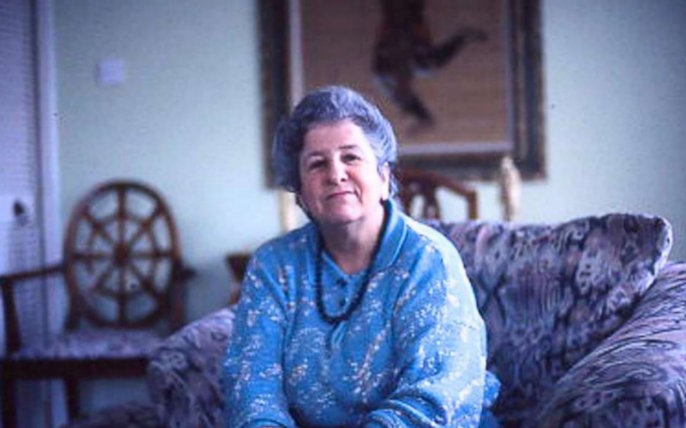
Fig. 10: Lilian Levy (*1939), who was married to Herbert Levy, started to attend BSS’s youth group shortly after she came to the UK as a child survivor in 1946. Levy was interviewed on 11 February 2000; by courtesy of Bea Lewkowicz.
For the children of refugees, the Belsize Square Synagogue provided a rare space of emotional safety and mutual understanding. It mitigated the sense of alienation many experienced in broader British society during and after the war. In that sense, BSS became not only a spiritual and cultural refuge but also a social anchor for the second generation.
The responses of the interviewees clearly demonstrate the importance of the synagogue community for each member. For many, the Belsize Square Synagogue preserved the German-Jewish liberale traditions brought from Germany. Even when their own children adopted different beliefs or assimilated into broader British culture, BSS stood as a guardian of this unique legacy. It helped refugees resettle in Britain by maintaining continuity with their past in a way that did not conflict with developing a British identity.
Though services were conducted in German and Hebrew until the late 1950s, the German language was difficult to preserve over generations. Many parents deliberately did not speak German with their children, hoping that this would ease their integration into British society. Still, the community maintained religious and cultural practices that created a sense of both memory and continuity.
The traditional link between past and present is eloquently captured in Rabbi Dr. Salzberger’s words, when he spoke (in German) on the occasion of the consecration of the new synagogue and community centre in 1951: “The house is consecrated. It is a monument of faithfulness to the past and belief in the future.”
Full interviews, including more oral history initiatives, can be accessed through the Bea Lewkowicz Archive: https://www.bealewkowicz.com/
Belsize Square Synagogue Website: https://synagogue.org.uk/
AJR Journal: the journal of the Association of Jewish Refugees (all issues from 1946): https://ajr.org.uk/ajr-journal/
Our Congregation: the news magazine of Belsize Square Synagogue (all issues from 1952): https://wiener.soutron.net/Portal/Default/en-GB/RecordView/Index/67023
More interviews with refugees from Nazi Europe who settled in the UK can be found on the Holocaust Testimony UK portal: https://www.holocausttestimony.org.uk/
This work is licensed under a Creative Commons Attribution - Non commercial - No Derivatives 4.0 International License. As long as the material is unedited and you give appropriate credit according to the Recommended Citation, you may reuse and redistribute it in any medium or format for non-commercial purposes.
Dr. Bea Lewkowicz (https://www.bealewkowicz.com/) is an oral historian and social anthropologist whose research addresses displacement, trauma, identity, and belonging through interviews with Holocaust survivors and refugees. She is the co-founder and Director of the AJR (Association of Jewish Refugees) Refugee Voices Testimony Archive and Sephardi Voices UK, and Project Lead of the Holocaust Testimony UK portal, a joint AJR/UK Government initiative. She is a member of the Research Centre for German & Austrian Exile Studies at the University of London and has been awarded an OBE for her services to Holocaust remembrance and education in 2026. She has directed many testimony-based films and curated exhibitions, such as Double Exposure (Literaturhaus Wien, 2011), Sephardi Voices, Still in Our Hands: Kinder Portraits (Jewish Museum London, 2017 and 2019), and, most recently, the digital installation 80 Objects | Holocaust Testimony (https://www.holocausttestimony.org.uk/80-objects). Her main publications include The Jewish Community of Salonika (2006), This Is the Story of My Life (2020), and Émigré Voices (2022).
Bea Lewkowicz, Oral Histories from Belsize Square Synagogue: Memory, Community, and Belonging, in: (Hi)stories of the German-Jewish Diaspora, February 27, 2026. <https://diaspora.jewish-history-online.net/article/gjd:article-52> [October 12, 2026].
 This work is licensed under a Creative Commons Attribution - Non commercial - No Derivatives 4.0 International License. As long as the material is unedited and you give appropriate credit according to the Recommended Citation, you may reuse and redistribute it in any medium or format for non-commercial purposes.